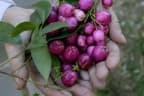
Myrtaceae FAMILY Endangered
Syzygium paniculatum
Syzygium paniculatum
Edibility
2/5
Medicinal
0/5
Safety & Hazards
None known
Cultivation Details
HabitEvergreen Shrub
GrowthSlow
Found in warm temperate to tropical areas of Australia[1]. It is not very cold-hardy, tolerating temperatures down to about -3°c[2]. Succeeds in full sun or partial shade[1]. Prefers a sandy soil, but grows in any good, well-drained soil[2, 3]. Plants are tolerant of poor soils[4].
Propagation
Seed - polyembryonic, usually producing several seedlings from each seed. Germination taks 3 - 4 weeks[3]. Stem cuttings root fairly easily[3]. Cite as: Temperate Plants Database, Ken Fern. temperate.theferns.info. 2026-02-21. <temperate.theferns.info/plant/Syzygium+paniculatum>
Pollinators
Bees
References
- [1]Trade Winds Fruit — http://www.tradewindsfruit.com/index.htm ↩︎The on-line catalogue of a company selling seeds. Gives descriptions, photos and uses of a very wide range of fruit and other food-producing plants plus ornamentals.
- [2]Conservatory and Indoor Plants Volumes 1 & 2 — Phillips. R. & Rix. M. · Pan Books, London. · 1998 · ISBN 0-330-37376-5 ↩︎Excellent photos of over 1,100 species and cultivars with habits and cultivation details plus a few plant uses. Many species are too tender for outdoors in Britain though there are many that can be grown outside.
- [3]Australian Rainforest Plants Volumes 1 - 6 — Nicholson N. & H. · Terania Rainforest Publishing; New South Wales. · 2007 · ISBN 9-78095894-3628 ↩︎Beautiful set of booklets with a terse description of over 600 species and their habitat, often including some of their uses and notes on their cultivation, plus at least one, excellent photograph.
- [4]Brazilian Fruits and Cultivated Exotics — Lorenzi. H.; Bacher. L.; Lacerda. M.; Sartori. S. · Instituto Plantarum De Estudos Da Flora LTDA; Brazil. · 2000 · ISBN 85-867174-24-0 ↩︎A superb book, giving information on several hundred fruit species. Each entry has a brief description of the plant and its uses, accompanied by one to many excellent quality photographs of the fruits.
- [5]The New RHS Dictionary of Gardening. 1992. — Huxley. A. · MacMillan Press · 1992 · ISBN 0-333-47494-5 ↩︎Excellent and very comprehensive, though it contains a number of silly mistakes. Readable yet also very detailed.
- [6]Mansfeld's Database of Agricultural and Horticultural Plants — http://mansfeld.ipk-gatersleben.de/pls/htmldb_pgrc/f?p=185:3:4292127278597336 ↩︎Terse details of a huge range of useful plants.
- [7]Bush Foods of New South Wales — Stewart S.; Percival B. · Royal Botanic gardens; Sydney, Australia. · 1997 · http://www.rbgsyd.nsw.gov.au/education/Resources/bush_foods · ISBN 07313-0004-1 ↩︎A small booklet with information on more than 30 species of edible plants. It can be downloaded from the Internet.
- [8]Cornucopia II — Facciola. S. · Kampong Publications, California. · 1998 · ISBN 0-9628087-2-5 ↩︎The second edition of an excellent guide to the edible uses of plants, though it does not give any details of cultivation etc.