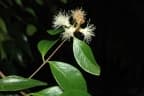
Syzygium luehmannii
Syzygium luehmannii
Safety & Hazards
None known
Cultivation Details
The plant grows naturally in a sub-tropical to tropical climate with a distinct dry season. However it can tolerate quite low temperatures in winter and mild frost, particularly after establishment[1]. No damage has been shown to occur with temperatures as low as 0°c[1]. Prefers a sunny position, but also tolerates moderate shade[1, 2]. Succeeds in both sandy and clay-based soils[1]. Sandy soils benefit from a reasonably high level of organic matter, minimising the need for irrigation. Prefers a pH in natural conditions of 4.5 - 5.5, but in cultivation can succeed with a pH up to 6.5[1]. The fruit is borne in great quantities[3]. Mature trees have been known to yield 70 kilos or more of fruit[1]. Plants grown from cuttings can produce fruit from their second year of growth, and have been shown to produce 3 - 5 kilos of marketable fruit per tree in the third year[1]. Plants grown from cuttings are usually much smaller than plants grown from seed[1]. Trees respond well to being cut back[1].
References
- [1]Australian Native Food Industry Limited — http://www.anfil.org.au/index.php/flavour-of-the-month/ ↩︎Information on a small number of Australian plants believed to have the potential for commercial growth.
- [2]Australian Rainforest Plants Volumes 1 - 6 — Nicholson N. & H. · Terania Rainforest Publishing; New South Wales. · 2007 · ISBN 9-78095894-3628 ↩︎Beautiful set of booklets with a terse description of over 600 species and their habitat, often including some of their uses and notes on their cultivation, plus at least one, excellent photograph.
- [3]Cornucopia II — Facciola. S. · Kampong Publications, California. · 1998 · ISBN 0-9628087-2-5 ↩︎The second edition of an excellent guide to the edible uses of plants, though it does not give any details of cultivation etc.
- [4]Flora of New South Wales — http://plantnet.rbgsyd.nsw.gov.au/floraonline.htm ↩︎An on-line resource giving a brief botanical description of all the native plants of New South Wales, their habitat and range, together with diagrams and photographs of the plants.
- [5]Australian Tropical Rainforest Plants — http://www.anbg.gov.au/cpbr/cd-keys/rfk/index.html ↩︎An online resource giving botanical information, and a little bit about plant usage, for over 2,700 species of plants found in the Australian rainforest.
- [6]Wild Food in Australia. — Cribb. A. B. and J. W. · Fontana · 1976 · ISBN 0-00-634436-4 ↩︎A very good pocket guide.
- [7]Wild Food Plants of Australia. — Low. T. · Angus and Robertson. · 1989 · ISBN 0-207-14383-8 ↩︎Well presented, clear information and good photographs. An interesting read for the casual reader as well as the enthusiast
- [8]Tropix 7 — CIRAD · http://tropix.cirad.fr/en ↩︎An on-line guide to the timbers of 245 species of trees.