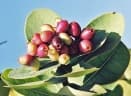
Syzygium cordatum
Syzygium cordatum
Safety & Hazards
Pieces of the bark or powdered bark are used as a fish poison for catching small fish in small ponds; it turns the water bluish for up to 3 days[1].
Cultivation Details
A plant of the subtropics and tropics, where it is found at elevations up to 1,200 metres. It grows best in areas where annual daytime temperatures are within the range 15 - 25°c, but can tolerate 10 - 35°c[2]. The tree is resistant to cold but not frost[1]. It prefers a mean annual rainfall in the range 750 - 1,200mm, but tolerates 600 - 1,500mm[2]. Prefers a sunny position[2]. Succeeds in most soils[2]. Plants can withstand extended periods of waterlogging[1]. Prefers a pH in the range 5.5 - 7, tolerating 5 - 7.5[2]. A fast-growing tree[3]. Trees 270cm tall within 27 months from seed have been recorded in Malawi[3]. Trees can be coppiced[3]. The tree is believed to grow naturally where there is underground water[1]. Plants are strongly fire resistant[1]. The tree is seen as an indicator of areas suitable for sugarcane farming[1]. A protected species in South Africa[1, 2]. Hybridizes freely with S. Guineense and S. Gerrardii where they occur together[1].
Propagation
Seed - pre-sowing treatment is not necessary[1]. Fresh seeds are sown directly into black nursery bags filled with a mixture of river sand and compost (3:2)[1]. Germination of fresh seed is very good and uniform, 90% after 25 days[3, 1]. All the flesh should be removed before seeds are dried in the shade[1]. The seed should not be dried - it has a viability of only one day once dried removed from the fruit[3]. Cite as: Tropical Plants Database, Ken Fern. tropical.theferns.info. 2026-02-20. <tropical.theferns.info/viewtropical.php?id=Syzygium+cordatum>
Pollinators
Bees, Insects
References
- [1]World Agroforesty Centre — http://www.worldagroforestry.org/ ↩︎An excellent online database of a huge range of trees giving very good information on each plant - its uses, ecology, identity, propagation, pests etc.
- [2]Ecocrop — http://ecocrop.fao.org/ecocrop/srv/en/home ↩︎Basic information on a wide range of useful plants, plus details of environmental needs where available.
- [3]Protabase - Plant Resources of Tropical Africa. — http://www.prota.org ↩︎An excellent on-line database with detailed information on over 3,200 species of useful plants of Africa.
- [4]Edible Wild Plants of Tanzania — Ruffo, C.K.: Birnie, A. & Tengnas, B. · Regional Land Management Unit; Nairobi. · 2002 · ISBN 9966-896-60-0 ↩︎A very well presented, simple guide to growing and utilizing wild food plants in Tanzania, with line drawings of each plant, a description, habitat and range, non-food as well as food uses, plus basic information on growing the plants.
- [5]IUCN Red List of Threatened Species — http://www.iucnredlist.org/ ↩︎A list of plants under threat and facing possible extinction, usually with brief details of the threats and information on habitat.
- [6]Cornucopia II — Facciola. S. · Kampong Publications, California. · 1998 · ISBN 0-9628087-2-5 ↩︎The second edition of an excellent guide to the edible uses of plants, though it does not give any details of cultivation etc.
- [7]Trade Winds Fruit — http://www.tradewindsfruit.com/index.htm ↩︎The on-line catalogue of a company selling seeds. Gives descriptions, photos and uses of a very wide range of fruit and other food-producing plants plus ornamentals.