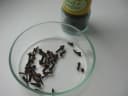
Syzygium aromaticum
Syzygium aromaticum
Safety & Hazards
None known
Cultivation Details
Cloves thrive in lowland humid tropical areas where the temperature is fairly steady, growing best in an island setting at elevations below 300 metres[1]. Notions about the ecological requirements of the clove vary, perhaps because of an underlying dilemma: a climate with a marked dry season promotes flowering, but the tree does not cope at all well with stress[2]. There are two ways out of this dilemma. The first is to choose a climate with a pronounced dry season, but to limit stress by going for deep fertile soils, providing water and shade during the early years[2]. The other way is to choose a wet climate with a short dry season[2]. The best quality cloves for use as a spice are grown in the wetter climates where annual rainfall is in excess of 1,500mm and usually in the range 3,000 - 4,000mm[2]. Requires a light, well-drained soil, requiring some shade, especially when young[1]. Growth can be sustained on poor and acid soils, but waterlogging is very harmful[2]. Requires shelter from the wind[2]. The clove tree is monoecious, flowers are hermaphrodite and self-pollinating. The tree matures between 8-10 years after planting[2]. Clove trees live for more than 100 years, the oldest tree recorded is aged 375 years in Indonesia[2]. Generally, it takes 20-30 years for clove to attain full bearing[2].
Propagation
Seed - the seed has a short viability of about 2 weeks so should be sown as soon as it is ripe in shady nursery beds, placing the seeds about 25mm deep in the soil[2]. About 70% of the seeds germinate, usually after 1 - 6 weeks[2]. Plant out when they are about 25cm tall[2]. Cuttings of terminal leafy softwood, kept in a frame at high humidity until they have rooted[1]. Cite as: Tropical Plants Database, Ken Fern. tropical.theferns.info. 2026-02-20. <tropical.theferns.info/viewtropical.php?id=Syzygium+aromaticum>
Pollinators
Bees
References
- [1]The New RHS Dictionary of Gardening. 1992. — Huxley. A. · MacMillan Press · 1992 · ISBN 0-333-47494-5 ↩︎Excellent and very comprehensive, though it contains a number of silly mistakes. Readable yet also very detailed.
- [2]World Agroforesty Centre — http://www.worldagroforestry.org/ ↩︎An excellent online database of a huge range of trees giving very good information on each plant - its uses, ecology, identity, propagation, pests etc.
- [3]Plants of Southeast Asia — http://www.asianplant.net/ ↩︎Excellent site with brief information on the plant, its range, habitat and uses, plus phots of specimens, close-ops of flowers and leaves etc,
- [4]Mansfeld's Database of Agricultural and Horticultural Plants — http://mansfeld.ipk-gatersleben.de/pls/htmldb_pgrc/f?p=185:3:4292127278597336 ↩︎Terse details of a huge range of useful plants.
- [5]Cornucopia II — Facciola. S. · Kampong Publications, California. · 1998 · ISBN 0-9628087-2-5 ↩︎The second edition of an excellent guide to the edible uses of plants, though it does not give any details of cultivation etc.
- [6]Encyclopaedia of Herbs and their Uses. — Bown. D. · Dorling Kindersley, London. · 1995 · ISBN 0-7513-020-31 ↩︎A very well presented and informative book on herbs from around the globe. Plenty in it for both the casual reader and the serious student. Just one main quibble is the silly way of having two separate entries for each plant.
- [7]Medicinal Plants of the Guianas — DeFilipps, R. A.; Maina, S. L.; & Crepin, J. · Smithsonian Museum · http://botany.si.edu/bdg/medicinal/index.html ↩︎A down-loadable PDF document of a book in pre-publication awaiting illustration. An excellent, if rather terse, guide to the traditional medicinal uses of the plants of the region