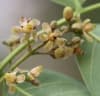
Swietenia humilis
Swietenia humilis
Safety & Hazards
The bark and seeds possess a stringent alkaloid, reputed to be very poisonous[1].
Cultivation Details
A plant of moderately dry tropical area, where it is found at elevations from near sea level to 1,200 metres[1]. It grows in areas with a distinct dry season[1]. This species hybridizes with S. macrophylla and S. mahagoni. Hybridization has been confirmed by cytological studies[1].
Propagation
Seed - when dried, it can be stored at ambient temperatures for several months[2]. Fresh seed requires no pre-treatment, but stored seed can germinate more readily if it is first soaked for 12 hours in warm water[2]. The seed is traditionally sown in situ[1]. Under nursery conditions, the seeds are sown in a shady position in a bed of light sand in 3 - 7cm deep furrows or holes or directly in containers. Seeds will germinate in 10 - 21 days[2]. Shades over nursery beds are removed and the seedlings hardened before planting out[2]. The seeds have a long storage life, probably in excess of 200 years in controlled conditions[1]. Cite as: Tropical Plants Database, Ken Fern. tropical.theferns.info. 2026-02-20. <tropical.theferns.info/viewtropical.php?id=Swietenia+humilis>
Pollinators
Bees
References
- [1]World Agroforesty Centre — http://www.worldagroforestry.org/ ↩︎An excellent online database of a huge range of trees giving very good information on each plant - its uses, ecology, identity, propagation, pests etc.
- [2]Seed Leaflets — Various · Forest & Landscape. Denmark · http://en.sl.life.ku.dk/Publikationer/Udgivelser/PopulaerPublikationer.aspx?katid={D28373CC-6EF3-4EF8-B097-6D83FABF209E}&serieid={9F1C3DB1-6E7B-4CF1-AF53-F480B0CB40EF}&sort=title ↩︎A series of leaflets, jointly produced by the University of Copenhagen and the Royal Botanic Gardens at Kew, focussing on seed information for a number species, but also giving a lot of other information about each plant.
- [3]IUCN Red List of Threatened Species — http://www.iucnredlist.org/ ↩︎A list of plants under threat and facing possible extinction, usually with brief details of the threats and information on habitat.
- [4]Flora of Guatemala — Standley P.C. & J. A. Steyermark · 1946 - 1976 · http://www.archive.org/ ↩︎A superb reference, though somewhat dated. Gives lots of plant uses as well as information on plant habit and habitat. The entire flora (13 volumes) can now be downloaded from http://www.archive.org/