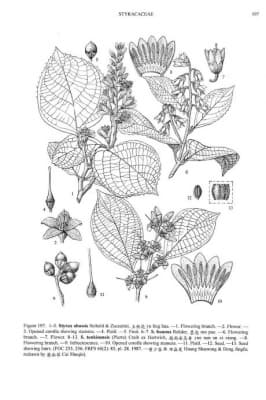
Styrax tonkinensis
Styrax tonkinensis
Safety & Hazards
None known
Cultivation Details
A plant of the subtropics to tropics, where it is found at elevations from 30 - 2,400 metres[1]. It is found in areas where the mean annual temperature is in the range 15 - 26°c, though it can survive occasional, short-lived, extreme temperatures as low as -4°c and as high as 45°c[2]. It prefers a mean annual rainfall in the range 1,500 - 2,200mm, though it can tolerate as little as 1,300mm in cultivation[2]. It grows in areas with no distinct dry season, or only a short dry season[2]. Requires a sunny position[2]. Styrax tonkinensis is fast growing and under favourable conditions can attain annual height increments of 3 metres during the first three years pf growth[3]. A mean height of 18 - 25 metres, with stems 20 - 24cm in diameter, are obtainable at 10 years. Such growth would give a wood yield of about 150 cubic metres per hectare based on final stand densities of approximately 600 - 800 stems per hectare[3]. Trees are tapped for their resin from the age of about 6 - 7 years. Tapping continues for 3 - 4 years, or until production declines[3]. Trees have a shallow rooting system[3].
Propagation
Seed - it soon loses its viability if it is allowed to dry out, but can be stored for at least a year at 20°c if it is kept moist[2]. Fresh seed needs a period of after-ripening or it will take several months to germinate. This is done by placing the fruits in 30 - 40cm deep layers in trays in the shade for 5 - 6 days and turning them over daily to provide aeration[2]. When the pericarp turns yellow or grey, the seeds are extracted and then dried in the shade for 4 - 5 days[2]. Sow the seed in 50% shade and germination should take 2 - 5 weeks[2]. Grown the plants on in 70% light and plant out when 25 - 50cm tall, which usually takes about 3 - 7 months[2]. Cite as: Tropical Plants Database, Ken Fern. tropical.theferns.info. 2026-02-20. <tropical.theferns.info/viewtropical.php?id=Styrax+tonkinensis>
Pollinators
Data unavailable
References
- [1]Annals of the Missouri Botanical Garden Vol. 90 — Missouri Botanical Garden · 2003 · http://www.biodiversitylibrary.org · ISBN 0026-6493 ↩︎A treatment of the genus Styrax, amongst many other articles. It can be downloaded from the Internet.
- [2]Seed Leaflets — Various · Forest & Landscape. Denmark · http://en.sl.life.ku.dk/Publikationer/Udgivelser/PopulaerPublikationer.aspx?katid={D28373CC-6EF3-4EF8-B097-6D83FABF209E}&serieid={9F1C3DB1-6E7B-4CF1-AF53-F480B0CB40EF}&sort=title ↩︎A series of leaflets, jointly produced by the University of Copenhagen and the Royal Botanic Gardens at Kew, focussing on seed information for a number species, but also giving a lot of other information about each plant.
- [3]World Agroforesty Centre — http://www.worldagroforestry.org/ ↩︎An excellent online database of a huge range of trees giving very good information on each plant - its uses, ecology, identity, propagation, pests etc.
- [4]Flora of China — Missouri Botanical Garden Press; St. Louis. · 1994 · http://flora.huh.harvard.edu/china/ ↩︎An excellent, comprehensive resource in 25 volumes. In addition to the botanical information the flora also gives basic information on habitat and some uses. An on-line version is also available.
- [5]Chinese Herbal Medicine Materia Medica — Bensky D., Clavey S. & Stöger E. · Eastland Press Inc; Seattle, USA · 2004 · ISBN 0-939616-4-24 ↩︎
- [6]A Taxonomic Revision of Taxa in Styrax Series Cyrta (Styracaceae) with Valvate Corollas — Li G. & Fritsch P.W. · 2018 ↩︎
- [7]IUCN Red List of Threatened Species — http://www.iucnredlist.org/ ↩︎A list of plants under threat and facing possible extinction, usually with brief details of the threats and information on habitat.
- [8]Cornucopia II — Facciola. S. · Kampong Publications, California. · 1998 · ISBN 0-9628087-2-5 ↩︎The second edition of an excellent guide to the edible uses of plants, though it does not give any details of cultivation etc.
- [9]Dictionary of Economic Plants. — Uphof. J. C. Th. · Weinheim · 1959 · ISBN - ↩︎An excellent and very comprehensive guide but it only gives very short descriptions of the uses without any details of how to utilize the plants. Not for the casual reader.