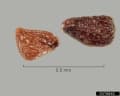
Striga gesnerioides
Striga gesnerioides
Safety & Hazards
None known
Cultivation Details
In general, the genus Striga is found in the semi-arid to moist tropics, tolerating a relatively wide range of climatic and soil conditions. It grows in areas with a mean annual rainfall ranging from 250 - 1,500mm per year, with a decrease in the severity of infestation in areas with higher rainfall[1]. Striga gesnerioides is a major pest problem in agriculture, especially in semi-arid marginal areas, parasitizing a range of crops, especially legumes[2]. Globally, the genus Striga has a greater impact on human welfare than any other parasitic angiosperms because their hosts are often subsistence crops in areas marginal for agriculture[1]. These furtive pathogens attack their hosts underground and, by the time the flowering stem of the parasite emerges and is evident, the crop is damaged[1]. Control of the parasite is difficult to achieve because of the intimate association between the parasitic weed and its host. The seeds germinate in response to specific germination stimulants exuded by host roots. After germination, a haustorium is formed in the root of the host plant through differentiation of the root apex. A vascular connection is subsequently established between the two plants, allowing the parasite to absorb water and nutrients that are essential for its development[2]. Striga gesnerioides as a whole has a very broad host range. It is a major pest in cowpea, parasitizing the roots and often considerably reducing its growth and yield. In the wild it parasitizes leguminous weeds, particularly Tephrosia and Indigofera in West Africa, but also Convolvulaceae (e.g. In Sudan Merremia, Ipomoea and Jacquemontia) and Euphorbiaceae[2]. Due to its autogamous nature, many different strains have evolved that can attack few or only a single plant species. These strains vary in their morphology and their distribution often overlaps. In West Africa there are at least five different strains that parasitize cowpea and each one varies in the number of cultivars it can attack. Tobacco and sweet potato are occasionally attacked. Strains attacking tobacco in Zimbabwe do not affect cowpea. Bambara groundnut is not affected; evidence of the occurrence of Striga gesnerioides on groundnut is conflicting[2]. The cultivation of crops such as cowpea in monoculture and without fallow years or rotation crops results in a rapid increase of favourable circumstances for growth of Striga which, on poor soils, can reduce yield by more than 50%[2].
Propagation
Seed - optimum temperature for seed germination is between 30 - 40°c, with no germination at 15°c or lower, or higher than 45°c[1]. Cite as: Tropical Plants Database, Ken Fern. tropical.theferns.info. 2026-02-20. <tropical.theferns.info/viewtropical.php?id=Striga+gesnerioides>
Pollinators
Self
References
- [1]nnals of the Missouri Botanical Garden Vol. 88 — Missouri Botanical Garden Press; St. Louis. · 2001 · http://www.biodiversitylibrary.org · ISBN 0026-6493 ↩︎A botanical publication with a range of articles on plants, including a treatment of the genus Striga in Africa.
- [2]Protabase - Plant Resources of Tropical Africa. — http://www.prota.org ↩︎An excellent on-line database with detailed information on over 3,200 species of useful plants of Africa.
- [3]Traditional Ethnomedicinal Knowledge Confined to the Pawra Tribe of Satpura Hills, Maharashtra, India. — Jagtap S.D.; Deokule S.S.; Pawar P.K.; Harsulkar A.M. · 2009 · http://www.ethnoleaflets.com/ · ISBN 1948-3570 ↩︎Information on the traditional medicinal use of plants by the Pawra tribe in Maharashtra, India. It can be downloaded from the Internet.