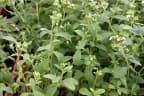
Stevia rebaudiana
Stevia rebaudiana
Safety & Hazards
None known
Cultivation Details
A plant of the subtropics and tropics, where it can be cultivated at elevations from sea level up to 1,500 metres. It can also be grown in more or less frost-free regions of the temperate zone. It grows best in areas where annual daytime temperatures are within the range 18 - 30°c, but can tolerate 15 - 43°c[1]. When dormant, the plant can survive temperatures down to about -6°c, but young growth can be severely damaged at 0°c[1]. It prefers a mean annual rainfall in the range 1,000 - 1,400mm, but tolerates 500 - 1,800mm[1]. Prefers a sandy soil, requiring a warm sunny position[2]. Prefers a pH in the range 5 - 6.5, tolerating 4 - 7.5[1]. A first harvest can take place 2 months after planting, which is about 6 months after sowing the seed[1]. Further harvests can be taken at monthly intervals and can continue for about 5 years before the plants will need to be replaced[1]. Flowering occurs 40 - 60 days after sowing or cutting. Long days, however, promote more leaf production resulting in a higher content of stevioside, on dry-matter basis[1]. In Japan, the yield in the first year is 400 - 500 kilos per hectare of the dried leaves, while yields in the following years vary between 1.5 - 2 tonnes of dry leaves. In western Java a yearly production of 3 tonnes of dry leaves is possible[1].
Propagation
Seed - sow spring in a warm greenhouse and only just cover the seed. Make sure the compost does not dry out. Prick out the seedlings into individual pots and grow them on fast, planting them out after the last expected frosts. It could be worthwhile giving them some protection such as a cloche or cold frame for a few weeks after planting them out until they are growing away well. Cite as: Temperate Plants Database, Ken Fern. temperate.theferns.info. 2026-02-21. <temperate.theferns.info/plant/Stevia+rebaudiana>
Pollinators
Insects
References
- [1]Ecocrop — http://ecocrop.fao.org/ecocrop/srv/en/home ↩︎Basic information on a wide range of useful plants, plus details of environmental needs where available.
- [2]The New RHS Dictionary of Gardening. 1992. — Huxley. A. · MacMillan Press · 1992 · ISBN 0-333-47494-5 ↩︎Excellent and very comprehensive, though it contains a number of silly mistakes. Readable yet also very detailed.
- [3]Cornucopia - A Source Book of Edible Plants. — Facciola. S. · Kampong Publications · 1990 · ISBN 0-9628087-0-9 ↩︎Excellent. Contains a very wide range of conventional and unconventional food plants (including tropical) and where they can be obtained (mainly N. American nurseries but also research institutes and a lot of other nurseries from around the world.
- [4]A Modern Herbal. — Grieve. · Penguin · 1984 · ISBN 0-14-046-440-9 ↩︎Not so modern (1930's?) but lots of information, mainly temperate plants.
- [5]Dictionary of Economic Plants. — Uphof. J. C. Th. · Weinheim · 1959 · ISBN - ↩︎An excellent and very comprehensive guide but it only gives very short descriptions of the uses without any details of how to utilize the plants. Not for the casual reader.
- [6]A Dictionary of Plants Used by Man. — Usher. G. · Constable · 1974 · ISBN 0094579202 ↩︎Forget the sexist title, this is one of the best books on the subject. Lists a very extensive range of useful plants from around the world with very brief details of the uses. Not for the casual reader.
- [7]Tanaka's Cyclopedia of Edible Plants of the World. — Tanaka. T. & Nakao S. · Keigaku Publishing; Tokyo · 1976 · ISBN - ↩︎The most comprehensive list of edible plants I've come across. Only the briefest entry for each species, though, and some of the entries are more than a little dubious. Not for the casual reader.
- [8]Plants for Human Consumption. — Kunkel. G. · Koeltz Scientific Books · 1984 · ISBN 3874292169 ↩︎An excellent book for the dedicated. A comprehensive listing of Latin names with a brief list of edible parts.
- [9]Philippine Medicinal Plants — http://www.stuartxchange.org/CompleteList.html ↩︎A lovely site, giving brief details on the medicinal uses of several hundred (over 400 at the last count) plants in the Philippines, plus a picture of each plant.
- [10]CosIng — http://ec.europa.eu/growth/tools-databases/cosing/ ↩︎CosIng is the European Commission database for information on cosmetic substances and ingredients.
- [PFAF]Plants for a Future — pfaf.org ↩︎