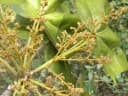
Sterculia urens
Sterculia urens
Safety & Hazards
The fruits are armed with stiff, stinging hairs that cause intolerable itching, if touched or handled; oil removes the hairs, and the itching, effectively[1].
Cultivation Details
Sterculia urens is a plant of low elevations in the arid to moist tropics, where it is usually found at elevations from 300 - 750 metres[2]. It grows best in areas where annual daytime temperatures are within the range 30 - 42°c, though it can tolerate 7 - 47°c[2]. It can be killed by temperatures of -2°c[2]. It prefers a mean annual rainfall within the range 750 - 1,200mm, but tolerates 200 - 2,000mm, usually growing in areas with a distinct dry season[2]. Requires a sunny position, though seedlings are shade tolerant[3, 2]. Grows best in a light, well-drained soil[2]. Very tolerant of poor, rocky soils[3, 2]. Established plants are very drought tolerant[2]. Prefers a pH in the range 6 - 7, but tolerates 5.5 - 7.8[2]. The trees can be tapped for their gum about 5 times during their lifetime[2]. The gum is collected in India after making incisions or wounds in the trunk and branches of the tree. The gum that exudes from these wounds is allowed to solidify to form irregular tears that are consequently cleaned and sorted[4]. The trees are generally worked under some form of coppice system on a rotation of 30 - 40 years[2].
Propagation
Seed - germination takes 10 - 15 days and gives nearly 100 % seedlings that reach 15 - 20cm in height n three months[3]. A physical dormancy caused by the hard seed coat of the mature seeds of many species in this genus can be overcome by scarifying the seed. This is carried out by cutting away or abrading some of the seed coat to allow the ingress of water, though great care must be taken not to damage the embryo[5]. The aril surrounding the seed should also be removed - this is easiest when it has been softened through soaking in water[5]. The seeds germinate optimally at temperatures between 20 - 30°c. They can be sown in a nursery seedbed or in containers. A germination rate of about 95%, occurring within about 2 weeks can be expected if the seed has been properly treated[5]. Cite as: Tropical Plants Database, Ken Fern. tropical.theferns.info. 2026-02-20. <tropical.theferns.info/viewtropical.php?id=Sterculia+urens>
Pollinators
Data unavailable
References
- [1]Indian Medicinal Planta — Kirkitar K.R.; Basu B.D. & Indian Civil Service · Sudhindra Nath Basu, BahadurGanj; India · 1918 ↩︎
- [2]Ecocrop — http://ecocrop.fao.org/ecocrop/srv/en/home ↩︎Basic information on a wide range of useful plants, plus details of environmental needs where available.
- [3]World Agroforesty Centre — http://www.worldagroforestry.org/ ↩︎An excellent online database of a huge range of trees giving very good information on each plant - its uses, ecology, identity, propagation, pests etc.
- [4]Sterculia and Brachychiton: a comprehensive overview on their ethnopharmacology, biological activities, phytochemist — Thabet A.A. et al · 2018 · http://10.1111/jphp.12876 ↩︎
- [5]Seed Leaflets — Various · Forest & Landscape. Denmark · http://en.sl.life.ku.dk/Publikationer/Udgivelser/PopulaerPublikationer.aspx?katid={D28373CC-6EF3-4EF8-B097-6D83FABF209E}&serieid={9F1C3DB1-6E7B-4CF1-AF53-F480B0CB40EF}&sort=title ↩︎A series of leaflets, jointly produced by the University of Copenhagen and the Royal Botanic Gardens at Kew, focussing on seed information for a number species, but also giving a lot of other information about each plant.
- [6]Trade in Indian Medicinal Plants — D.K.Ved, S.Noorunnisa Begum, & K.Ravi Kumar · Apple Academic Press; Oakville, Canada · 2018 · ISBN 978-1-77188-600-0 ↩︎
- [7]Mansfeld's Database of Agricultural and Horticultural Plants — http://mansfeld.ipk-gatersleben.de/pls/htmldb_pgrc/f?p=185:3:4292127278597336 ↩︎Terse details of a huge range of useful plants.
- [8]Pharmacographia Indica — Dymock W.; Warden C.J.H.; Hooper D. · Education Society's Press, Byculla; Mombai. · 1890 · http://www.biodiversitylibrary.org ↩︎Information on the principal plant medicines encountered in India in the 19th century.
- [9]Flowers of India — http://www.flowersofindia.net/ ↩︎A wed site of native Indian plants, plus cultivated and naturalized species. It has good quality photos and terse details on more than 3,000 species and cultivars.
- [10]Cornucopia II — Facciola. S. · Kampong Publications, California. · 1998 · ISBN 0-9628087-2-5 ↩︎The second edition of an excellent guide to the edible uses of plants, though it does not give any details of cultivation etc.
- [11]Glossary of Indian Medicinal Plants (Including the Supplement). — Chopra. R. N., Nayar. S. L. and Chopra. I. C. · Council of Scientific and Industrial Research, New Delhi. · 1986 · ISBN - ↩︎Very terse details of medicinal uses of plants with a wide range of references and details of research into the plants chemistry. Not for the casual reader.
- [12]Indian Medicinal Plants; An Illustrated Dictionary — Khare C.P. (Ed.) · Springer-Verlag Berlin/Heidelberg · 2007 · ISBN 978-0-387-70637-5 ↩︎
- [13]Biodiversity of Medicinal Plants in the Eastern Ghats of Northern Andhra Pradesh, India — Venkaiah M., Prakasa Rao J. & R. Prameela R. · Springer Nature; Singapore · 2020 · https://doi.org/10.1007/978-981-15-1636-8 · ISBN 978-981-15-1635- ↩︎
- [14]Ethnobotanicals of the Western Ghats — Noorunnisa Begum S., Ravikumar K. & Ved D.K. · Apple Academic Press; Oakville, Canada · 2017 · ISBN 978-1-77188-404-4 ↩︎
- [PFAF]Plants for a Future — pfaf.org ↩︎