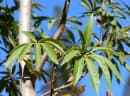
Sterculia murex
Sterculia murex
Safety & Hazards
The shell contains large oval seeds, resting in a bed of stinging hairs that can be irritating on contact with the skin or eyes[1].
Cultivation Details
A tree of the subtropics in northern S. Africa. Plants are not tolerant of frost[1]. Prefers a well-drained soil[1]. A fast-growing tree[1].
Propagation
Seed - germinates readily if sown fresh[1]. For better germination, the seed should be placed on top of the soil. The roots are formed first and the leaves only appear above the soil or the growing medium after a few months[1]. A physical dormancy caused by the hard seed coat of the mature seeds of many species in this genus can be overcome by scarifying the seed. This is carried out by cutting away or abrading some of the seed coat to allow the ingress of water, though great care must be taken not to damage the embryo[2]. The aril surrounding the seed should also be removed - this is easiest when it has been softened through soaking in water[2]. The seeds germinate optimally at temperatures between 20 - 30°c. They can be sown in a nursery seedbed or in containers. A germination rate of about 95%, occurring within about 2 weeks can be expected if the seed has been properly treated[2]. Cite as: Tropical Plants Database, Ken Fern. tropical.theferns.info. 2026-02-20. <tropical.theferns.info/viewtropical.php?id=Sterculia+murex>
Pollinators
Data unavailable
References
- [1]PlantZAfrica.com — http://www.plantzafrica.com ↩︎An excellent site giving detailed descriptions and uses of many S. African plants.
- [2]Seed Leaflets — Various · Forest & Landscape. Denmark · http://en.sl.life.ku.dk/Publikationer/Udgivelser/PopulaerPublikationer.aspx?katid={D28373CC-6EF3-4EF8-B097-6D83FABF209E}&serieid={9F1C3DB1-6E7B-4CF1-AF53-F480B0CB40EF}&sort=title ↩︎A series of leaflets, jointly produced by the University of Copenhagen and the Royal Botanic Gardens at Kew, focussing on seed information for a number species, but also giving a lot of other information about each plant.
- [3]Pharmaceutical monographs for 60 South African plant species — Scott, G. and Springfield, E.P. · 2004 · http://www.plantzafrica.com/medmonographs ↩︎A series of 60 monographs of S. African medicinal plants. Well written, with information on traditional uses and modern research into the plants.