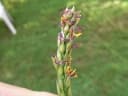
Stenotaphrum secundatum
Stenotaphrum secundatum
Safety & Hazards
None known
Cultivation Details
A plant of the lowland tropics to the warm temperate zone. It is found at elevations up to 800 metres in the tropics. It grows best in areas where annual daytime temperatures are within the range 18 - 30°c, but can tolerate 10 - 34°c[1]. When dormant, the plant can survive temperatures down to about -4°c, but young growth can be severely damaged at -1°c[1]. Diploid types are more tolerant of cold and frost than many tropical grasses. Triploid forms have poor cool season growth[2]. It prefers a mean annual rainfall in the range 800 - 2,000mm, but tolerates 300 - 3,300mm[1]. Succeeds in full sun and also tolerates quite considerable shade[2]. Found on a wide range of well or poorly drained soils, from sandy loams to light clays[2]. Found in infertile to moderately fertile soils. It has good tolerance of soil salinity (to 15 dS/cm) and of wind-borne salt from the sea[2]. Prefers a pH in the range 6 - 7.5, tolerating - 8.5[1].While moderately drought tolerant, it prefers good moisture, and can also withstand temporary flooding and waterlogging[2]. There are some reports of the plant invading native habitats[3], but it has shown a low potential to become a problem[2].
Propagation
Seed -rarely produced[2]. The plant is normally propagated vegetatively because seed is not commercially available. To establish a good ground cover, use well-rooted sprigs or 7-10 cm plugs, planted 30cm apart in rows 60 - 70 cm apart[2]. The plant can also be established by broadcasting stolons or sprigs at 3.5 - 7 cubic metres per hectare and discing them into the soil and then rolling the ground[2]. The plants may take 5 - 6 months to form a complete cover, but establish faster under light to moderate shade[2]. Cite as: Tropical Plants Database, Ken Fern. tropical.theferns.info. 2026-02-20. <tropical.theferns.info/viewtropical.php?id=Stenotaphrum+secundatum>
Pollinators
Data unavailable
References
- [1]Ecocrop — http://ecocrop.fao.org/ecocrop/srv/en/home ↩︎Basic information on a wide range of useful plants, plus details of environmental needs where available.
- [2]Tropical Forages — http://www.tropicalforages.info/key/Forages/Media/Html/index.htm ↩︎Mainly focussed on forage plants, the site gives a lot of information on the plant, with a good botanical description, details of cultivation, plant uses and a good selection of photographs.
- [3]Pacific Island Ecosystems at Risk — http://www.hear.org/pier/scientificnames/index.html ↩︎A very good website detailing weed species that have been introduced into the Pacific Islands.
- [4]Grassland Species - Profiles — http://www.fao.org/ag/AGP/AGPC/doc/Gbase/Default.htm ↩︎Terse information on over 650 species of plants that grow in grassland, including trees, shrubs and perennial plants as well as grasses. Gives a brief description of the plant, its range and habitat and some of its uses.