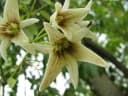
Stauntonia hexaphylla
Stauntonia hexaphylla
Safety & Hazards
None known
Cultivation Details
Stauntonia hexaphylla is native to the warm temperate and subtropical climates of southern Japan. It is not very cold-hardy, being able to tolerate short periods with temperatures down to about -10°c when the plant is fully dormant[1, 2, 3, 4]. The young growth in spring, however, is more sensitive to cold and can be damaged by late frosts. Requires a well-drained moisture retentive soil in a sheltered position[5]. Succeeds in acid or alkaline soils, in full sun or in semi-shade[5]. It grows best if its roots are in a shady position and the top is allowed to grow into the sun[PFAF]. A very ornamental plant[5]. The flowers have a pleasant sweet perfume[6]. A climbing plant that supports itself by twining around other plants and supports[7]. Plants are dioecious but females have borne fruit at times in the absence of a male pollinator[2, 5]. In Britain fruit is usually only formed in sunny summers[8, 7]. Hand pollination may improve fruit set[8]. Male and female plants must be grown if seed is required.
Propagation
Seed - sow early spring in a greenhouse. The seed can take 18 months to germinate. Prick out the seedlings into individual pots once they are large enough to handle and grow them on in the greenhouse for at least their first winter. Plant them out into their permanent positions in early summer and consider giving them some protection from the cold for their first winter or two outdoors[PFAF]. Cuttings. Cite as: Temperate Plants Database, Ken Fern. temperate.theferns.info. 2026-02-21. <temperate.theferns.info/plant/Stauntonia+hexaphylla>
Pollinators
Insects
References
- [1]Growing Unusual Fruit. — Simmons. A. E. · David & Charles; Newton Abbot. · 1972 · ISBN 0-7153-5531-7 ↩︎A very readable book with information on about 100 species that can be grown in Britain (some in greenhouses) and details on how to grow and use them.
- [2]Trees and Shrubs Hardy in Great Britain. Vol 1 - 4 and Supplement. — Bean. W. · Murray · 1981 · ISBN - ↩︎A classic with a wealth of information on the plants, but poor on pictures.
- [3]Trees and Shrubs in Cornwall. — Thurston. ↩︎Trees and shrubs that succeed in Cornwall based on the authors own observations. Good but rather dated.
- [4]Shrubs. — Phillips. R. & Rix. M. · Pan Books · 1989 · ISBN 0-330-30258-2 ↩︎Excellent photographs and a terse description of 1,900 species and cultivars.
- [5]The New RHS Dictionary of Gardening. 1992. — Huxley. A. · MacMillan Press · 1992 · ISBN 0-333-47494-5 ↩︎Excellent and very comprehensive, though it contains a number of silly mistakes. Readable yet also very detailed.
- [6]Scented Flora of the World. — Genders. R. · Robert Hale. London. · 1994 · ISBN 0-7090-5440-8 ↩︎An excellent, comprehensive book on scented plants giving a few other plant uses and brief cultivation details. There are no illustrations.
- [7]Gardening on Walls — Grey-Wilson. C. & Matthews. V. · Collins · 1983 · ISBN 0-00-219220-0 ↩︎A nice little book about plants for growing against walls and a small section on plants that can grow in walls.
- [8]The Milder Garden. — Taylor. J. · Dent · 1990 ↩︎A good book on plants that you didn't know could be grown outdoors in Britain.
- [9]Mansfeld's Database of Agricultural and Horticultural Plants — http://mansfeld.ipk-gatersleben.de/pls/htmldb_pgrc/f?p=185:3:4292127278597336 ↩︎Terse details of a huge range of useful plants.
- [10]Flora of Japan. (English translation) — Ohwi. G. · Smithsonian Institution · 1965 · ISBN - ↩︎The standard work. Brilliant, but not for the casual reader.
- [11]Sturtevant's Edible Plants of the World. — Hedrick. U. P. · Dover Publications · 1972 · ISBN 0-486-20459-6 ↩︎Lots of entries, quite a lot of information in most entries and references.
- [12]Famine Foods listed in the Chiu-Huang Pen-ts'ao. — Reid. B. E. · Southern Materials Centre; Taipei · 1977 · ISBN - ↩︎A translation of an ancient Chinese book on edible wild foods. Fascinating.
- [13]Dictionary of Economic Plants. — Uphof. J. C. Th. · Weinheim · 1959 · ISBN - ↩︎An excellent and very comprehensive guide but it only gives very short descriptions of the uses without any details of how to utilize the plants. Not for the casual reader.
- [14]Cornucopia - A Source Book of Edible Plants. — Facciola. S. · Kampong Publications · 1990 · ISBN 0-9628087-0-9 ↩︎Excellent. Contains a very wide range of conventional and unconventional food plants (including tropical) and where they can be obtained (mainly N. American nurseries but also research institutes and a lot of other nurseries from around the world.
- [15]The RHS Gardener's Encyclopedia of Plants and Flowers — Brickell. C. · Dorling Kindersley Publishers Ltd. · 1990 · ISBN 0-86318-386-7 ↩︎Excellent range of photographs, some cultivation details but very little information on plant uses.
- [16]Medicinal Plants of China — Duke. J. A. and Ayensu. E. S. · Reference Publications, Inc. · 1985 · ISBN 0-917256-20-4 ↩︎Details of over 1,200 medicinal plants of China and brief details of their uses. Often includes an analysis, or at least a list of constituents. Heavy going if you are not into the subject.
- [17]A Phenolic Glycoside and Triterpenoids from Stauntonia hexaphylla — Wang H et al · 1998 ↩︎
- [18]CosIng — http://ec.europa.eu/growth/tools-databases/cosing/ ↩︎CosIng is the European Commission database for information on cosmetic substances and ingredients.
- [PFAF]Plants for a Future — pfaf.org ↩︎