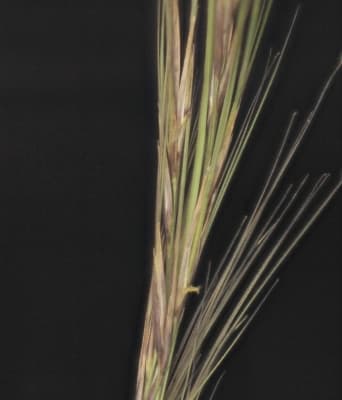
Sporobolus contractus
Sporobolus contractus
Safety & Hazards
None known
Cultivation Details
A plant mainly of the temperate and subtropical zones, just entering the tropics in Mexico. Succeeds in any well drained soil in a sunny position[1]. The plant is adapted to a wide range of soil types, but performs best on loamy fine, silty and sandy loam soils[2].
Propagation
Seed - sow spring in a greenhouse and only just cover the seed. Germination should take place within 2 weeks. Prick out the seedlings into individual pots when they are large enough to handle and plant them out in the summer if they have grown sufficiently. Otherwise, grow them on in a greenhouse for their first winter and plant them out in late spring of the following year. Division in spring. Larger divisions can be planted out direct into their permanent positions. We have found it best to pot up the smaller divisions and grow them on in a lightly shaded position in a cold frame, planting them out once they are well established in the summer. Cite as: Temperate Plants Database, Ken Fern. temperate.theferns.info. 2026-02-21. <temperate.theferns.info/plant/Sporobolus+contractus>
Pollinators
Wind
References
- [1]The New RHS Dictionary of Gardening. 1992. — Huxley. A. · MacMillan Press · 1992 · ISBN 0-333-47494-5 ↩︎Excellent and very comprehensive, though it contains a number of silly mistakes. Readable yet also very detailed.
- [2]Plants Database — United States Department of Agriculture · http://plants.usda.gov/java/factSheet ↩︎An online database with an excellent collection of fact sheets about native N. American plants.
- [3]Gray's Manual of Botany.Eighth Edition — Fernald. M. L. · American Book Co.; New York · 1950 · ISBN 0442222505 ↩︎A bit dated but a good and concise flora of the eastern part of N. America.
- [4]An Illustrated Flora of the Northern United States and Canada — Britton. N. L. Brown. A. · Dover Publications. New York. · 1970 · ISBN 0-486-22642-5 ↩︎Reprint of a 1913 Flora, but still a very useful book.
- [5]Tanaka's Cyclopedia of Edible Plants of the World. — Tanaka. T. & Nakao S. · Keigaku Publishing; Tokyo · 1976 · ISBN - ↩︎The most comprehensive list of edible plants I've come across. Only the briefest entry for each species, though, and some of the entries are more than a little dubious. Not for the casual reader.
- [6]Food Plants of the N. American Indians. — Yanovsky. E. · U.S. Depf of Agriculture. · ISBN - ↩︎A comprehensive but very terse guide. Not for the casual reader.
- [7]Native American Ethnobotany — Moerman. D. · Timber Press. Oregon. · 1998 · ISBN 0-88192-453-9 ↩︎Very comprehensive but terse guide to the native uses of plants. Excellent bibliography, fully referenced to each plant, giving a pathway to further information. Not for the casual reader.
- [PFAF]Plants for a Future — pfaf.org ↩︎