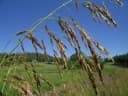
Sorghum halepense
Sorghum halepense
Safety & Hazards
The pollen can induce hay fever[1].
Cultivation Details
Originally from the Mediterranean and west Asia, Johnson grass has spread to many areas of the world, including the tropics. It is best adapted to warm humid summer-rainfall areas in the subtropics, not growing well in strictly tropical areas[1]. It grows best in areas where annual daytime temperatures are within the range 24 - 32°c, but can tolerate 15 - 36°c[2]. Temperatures below 13°c tend to inhibit flowering[1]. When dormant, the plant can survive temperatures down to about -7°c, but young growth can be severely damaged at -1°c[2]. It prefers a mean annual rainfall in the range 500 - 750mm, but tolerates 450 - 1,500mm[2]. Prefers a warm sunny position[3]. An easily grown plant, it succeeds in ordinary garden soil[3]. It is adapted to a wide range of soil types, including upland clay, but seems to do best on porous fertile lowlands and river bottoms[1]. It does well on heavy clay soils of relatively high fertility and water holding capacity[1]. Prefers a pH in the range 6 - 6.8, tolerating 4.9 - 8.2[2]. A parent of the cultivated Sorghum (S. Bicolor)[4]. Classified as a short day plant, it does not flower if the daylight hours exceed about 13 hours per day[1]. Rhizomes production may be 10-50 t/ha. Seed yields of 0.3 t/ha are considered good[2]. A day-length of 12 hours is thought to be the optimum for flowering, with above 14 hours of light the grass fails to flower, and above 16 hours all growth processes are inhibited[2].
Propagation
Seed - sow mid spring in a greenhouse and only just cover the seed. Germination should take place within 2 weeks. Prick out the seedlings into individual pots once they are large enough to handle and plant them out after the last expected frosts. Division in mid spring as the plant comes into new growth. Larger divisions can be planted out direct into their permanent positions. We have found it best to pot up the smaller divisions and grow them on in a lightly shaded position in a cold frame, planting them out once they are well established in the summer. Cite as: Temperate Plants Database, Ken Fern. temperate.theferns.info. 2026-02-21. <temperate.theferns.info/plant/Sorghum+halepense>
Pollinators
Wind
References
- [1]Handbook of Energy Crops — Duke. J. · - · 1983 · https://hort.purdue.edu/newcrop/duke_energy/dukeindex.html · ISBN - ↩︎Published only on the Internet, excellent information on a wide range of both temperate and tropical plants.
- [2]Ecocrop — http://ecocrop.fao.org/ecocrop/srv/en/home ↩︎Basic information on a wide range of useful plants, plus details of environmental needs where available.
- [3]RHS Dictionary of Plants plus Supplement. 1956 — F. Chittendon. · Oxford University Press · 1951 · ISBN - ↩︎Comprehensive listing of species and how to grow them. Somewhat outdated, it has been replaced in 1992 by a new dictionary (see [ 200 ]).
- [4]Economic Botany. — Hill. A. F. · The Maple Press · 1952 · ISBN - ↩︎Not very comprehensive, but it is quite readable and goes into some detail about the plants it does cover.
- [5]Flora of China — Missouri Botanical Garden Press; St. Louis. · 1994 · http://flora.huh.harvard.edu/china/ ↩︎An excellent, comprehensive resource in 25 volumes. In addition to the botanical information the flora also gives basic information on habitat and some uses. An on-line version is also available.
- [6]Dictionary of Economic Plants. — Uphof. J. C. Th. · Weinheim · 1959 · ISBN - ↩︎An excellent and very comprehensive guide but it only gives very short descriptions of the uses without any details of how to utilize the plants. Not for the casual reader.
- [7]Perennial Garden Plants — Thomas. G. S. · J. M. Dent & Sons, London. · 1990 · ISBN 0 460 86048 8 ↩︎A concise guide to a wide range of perennials. Lots of cultivation guides, very little on plant uses.
- [8]Flora Europaea — ? · Cambridge University Press · 1964 · ISBN - ↩︎An immense work in 6 volumes (including the index). The standard reference flora for Europe, it is very terse though and with very little extra information. Not for the casual reader.
- [9]Tanaka's Cyclopedia of Edible Plants of the World. — Tanaka. T. & Nakao S. · Keigaku Publishing; Tokyo · 1976 · ISBN - ↩︎The most comprehensive list of edible plants I've come across. Only the briefest entry for each species, though, and some of the entries are more than a little dubious. Not for the casual reader.
- [10]Glossary of Indian Medicinal Plants (Including the Supplement). — Chopra. R. N., Nayar. S. L. and Chopra. I. C. · Council of Scientific and Industrial Research, New Delhi. · 1986 · ISBN - ↩︎Very terse details of medicinal uses of plants with a wide range of references and details of research into the plants chemistry. Not for the casual reader.