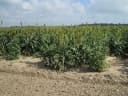
Sorghum bicolor
Sorghum bicolor
Safety & Hazards
The immature plant is poisonous, especially if slightly wilted, since it can contain the toxins hydrogen cyanide and the alkaloid hordenine[1, 2, 3]. These substances are destroyed if the plant is dried or made into silage[3]. In small quantities, hydrogen cyanide has been shown to stimulate respiration and improve digestion, it is also claimed to be of benefit in the treatment of cancer. In excess, however, it can cause respiratory failure and even death.
Cultivation Details
Sorghum bicolor is a plant of the tropics and subtropics, where it is found main in semi-arid areas and at elevations up to 2,500 metres. It is also cultivated in many areas of the temperate zone, especially where the summers tend to be hot. It grows best in areas where annual daytime temperatures are within the range 22 - 35°c, but can tolerate 8 - 40°c[4].It prefers a mean annual rainfall in the range 400 - 600mm, but tolerates 300 - 700mm[4]. A fairly easily grown plant, requiring a warm, sheltered and sunny position[5], preferring a slightly to moderately acid soil[5, 3], though some cultivars have succeeded with a pH as high as 8[3]. Plants are adapted to a wide range of soils varying from light loams to heavy clays, they thrive best on light, easily worked soils of high fertility, with moderate to high availability of water[3]. Moderately well-drained soils are suitable for sorghums[3]. Prefers a pH in the range 5.5 - 7.5, tolerating 5 - 8[4]. Small amounts of alkali in sand reduces performance considerably[3]. Plants are moderately tolerant of saline soils[3]. Established plants are very drought resistant, they succeed in arid and nutrient-poor soils[6]. A nitrogen rich soil causes the plants to lodge[5]. Yields of around 6 tonnes per hectare have been achieved, though yields as low as 200 kilos have been reported - yields below 2 tonnes are not considered financially viable[3]. There are many named varieties[1, 7, 8, 9, 10]. There is a multiplicity of forms of cultivated sorghum, derived by human selection and all fully interfertile. Some forms have sweet culms. Many species names have been proposed in the past in an attempt to categorize this variation, but they represent no more than intergrading cultivars within the common species pool[11]. Some cultivars are short-day plants and are unlikely to produce flowers and seed away from the tropical zone[3].
Propagation
Seed - sow mid spring in a greenhouse and only just cover the seed. Germination should take place within 2 weeks if given a minimum germination temperature of 23°c[5]. Prick out the seedlings into individual pots once they are large enough to handle and plant them out after the last expected frosts. Consider giving them some protection, such as a cloche, until they are growing away strongly. Cite as: Temperate Plants Database, Ken Fern. temperate.theferns.info. 2026-02-21. <temperate.theferns.info/plant/Sorghum+bicolor>
Pollinators
Self, Wind
References
- [1]A Modern Herbal. — Grieve. · Penguin · 1984 · ISBN 0-14-046-440-9 ↩︎Not so modern (1930's?) but lots of information, mainly temperate plants.
- [2]Plants Consumed by Man. — Brouk. B. · Academic Press · 1975 · ISBN 0-12-136450-x ↩︎Readable but not very comprehensive.
- [3]Handbook of Energy Crops — Duke. J. · - · 1983 · https://hort.purdue.edu/newcrop/duke_energy/dukeindex.html · ISBN - ↩︎Published only on the Internet, excellent information on a wide range of both temperate and tropical plants.
- [4]Ecocrop — http://ecocrop.fao.org/ecocrop/srv/en/home ↩︎Basic information on a wide range of useful plants, plus details of environmental needs where available.
- [5]Wonder Crops. 1987. — Natural Food Institute, ↩︎Fascinating reading, this is an annual publication. Some reports do seem somewhat exaggerated though.
- [6]Economic Botany. — Hill. A. F. · The Maple Press · 1952 · ISBN - ↩︎Not very comprehensive, but it is quite readable and goes into some detail about the plants it does cover.
- [7]Flora Europaea — ? · Cambridge University Press · 1964 · ISBN - ↩︎An immense work in 6 volumes (including the index). The standard reference flora for Europe, it is very terse though and with very little extra information. Not for the casual reader.
- [8]A Dictionary of Plants Used by Man. — Usher. G. · Constable · 1974 · ISBN 0094579202 ↩︎Forget the sexist title, this is one of the best books on the subject. Lists a very extensive range of useful plants from around the world with very brief details of the uses. Not for the casual reader.
- [9]Cornucopia - A Source Book of Edible Plants. — Facciola. S. · Kampong Publications · 1990 · ISBN 0-9628087-0-9 ↩︎Excellent. Contains a very wide range of conventional and unconventional food plants (including tropical) and where they can be obtained (mainly N. American nurseries but also research institutes and a lot of other nurseries from around the world.
- [10]Cornucopia II — Facciola. S. · Kampong Publications, California. · 1998 · ISBN 0-9628087-2-5 ↩︎The second edition of an excellent guide to the edible uses of plants, though it does not give any details of cultivation etc.
- [11]Flora of China — Missouri Botanical Garden Press; St. Louis. · 1994 · http://flora.huh.harvard.edu/china/ ↩︎An excellent, comprehensive resource in 25 volumes. In addition to the botanical information the flora also gives basic information on habitat and some uses. An on-line version is also available.
- [12]Dictionary of Economic Plants. — Uphof. J. C. Th. · Weinheim · 1959 · ISBN - ↩︎An excellent and very comprehensive guide but it only gives very short descriptions of the uses without any details of how to utilize the plants. Not for the casual reader.
- [13]Protabase - Plant Resources of Tropical Africa. — http://www.prota.org ↩︎An excellent on-line database with detailed information on over 3,200 species of useful plants of Africa.
- [14]Sturtevant's Edible Plants of the World. — Hedrick. U. P. · Dover Publications · 1972 · ISBN 0-486-20459-6 ↩︎Lots of entries, quite a lot of information in most entries and references.
- [15]Plants for Man. — Schery. R. W. ↩︎Fairly readable but not very comprehensive. Deals with plants from around the world.
- [16]Ornamental Grasses. — Grounds. R. · Christopher Helm · 1989 · ISBN 0-7470-1219-9 ↩︎Cultivation details of many of the grasses and bamboos. Well illustrated.
- [17]Encyclopaedia of Medicinal Plants. — Chiej. R. · MacDonald · 1984 · ISBN 0-356-10541-5 ↩︎Covers plants growing in Europe. Also gives other interesting information on the plants. Good photographs.
- [18]Tanaka's Cyclopedia of Edible Plants of the World. — Tanaka. T. & Nakao S. · Keigaku Publishing; Tokyo · 1976 · ISBN - ↩︎The most comprehensive list of edible plants I've come across. Only the briefest entry for each species, though, and some of the entries are more than a little dubious. Not for the casual reader.
- [19]RHS Dictionary of Plants plus Supplement. 1956 — F. Chittendon. · Oxford University Press · 1951 · ISBN - ↩︎Comprehensive listing of species and how to grow them. Somewhat outdated, it has been replaced in 1992 by a new dictionary (see [ 200 ]).
- [20]Native American Ethnobotany — Moerman. D. · Timber Press. Oregon. · 1998 · ISBN 0-88192-453-9 ↩︎Very comprehensive but terse guide to the native uses of plants. Excellent bibliography, fully referenced to each plant, giving a pathway to further information. Not for the casual reader.
- [21]Chinese Materia Medica. — Stuart. Rev. G. A. · Taipei. Southern Materials Centre · 1911 · ISBN - ↩︎A translation of an ancient Chinese herbal. Fascinating.