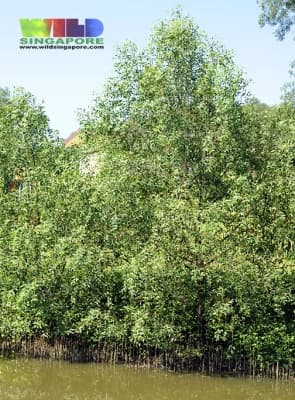
Sonneratia caseolaris
Sonneratia caseolaris
Safety & Hazards
None known
Cultivation Details
A plant of coastal areas in the tropics. It grows best where the mean annual minimum and maximum temperatures are within the range 20 - 30°c, though it tolerates 10 - 38°c[1]. It prefers a mean annual rainfall of 1,500 - 2,500mm, tolerating 1,000 - 3,000mm, and succeeds in areas with no dry season as well as those with a dry season. Prefers a sunny position[1]. Prefers a heavy soil, but tolerates most soil types[1]. Grows in areas that are inundated by salt water at high tides. Prefers a pH in the range 6.7 - 7.3, but tolerates 6.5 - 7.5[1]. Plants are tolerant of strong, salt-laden winds. The flowers are nocturnal, opening in the evening and closing in the early morning[2].
Propagation
Seed - it has a low viability of less than three months[3]. Cite as: Tropical Plants Database, Ken Fern. tropical.theferns.info. 2026-02-20. <tropical.theferns.info/viewtropical.php?id=Sonneratia+caseolaris>
Pollinators
Moths, bats, birds
References
- [1]Ecocrop — http://ecocrop.fao.org/ecocrop/srv/en/home ↩︎Basic information on a wide range of useful plants, plus details of environmental needs where available.
- [2]Flora Malesiana Series 1 — Various · Nationaal Herbarium Nederiand, Universiteit Leiden branch · http://www.archive.org ↩︎A massive treatment of the plants of the Malaysian Archipelago. Much of it has been made available to download from the Internet
- [3]IUCN Red List of Threatened Species — http://www.iucnredlist.org/ ↩︎A list of plants under threat and facing possible extinction, usually with brief details of the threats and information on habitat.
- [4]Flora of China — Missouri Botanical Garden Press; St. Louis. · 1994 · http://flora.huh.harvard.edu/china/ ↩︎An excellent, comprehensive resource in 25 volumes. In addition to the botanical information the flora also gives basic information on habitat and some uses. An on-line version is also available.
- [5]Minor Products of Philippine Forests — Brown. W. H. · Bureau of Forestry, Manilla. · 1920 ↩︎A useful guide to some of the plants of the area, though terse on details. The book is out of copyright and can be legally downloaded from the Internet.
- [6]Cornucopia II — Facciola. S. · Kampong Publications, California. · 1998 · ISBN 0-9628087-2-5 ↩︎The second edition of an excellent guide to the edible uses of plants, though it does not give any details of cultivation etc.
- [7]Handbook of Energy Crops — Duke. J. · - · 1983 · https://hort.purdue.edu/newcrop/duke_energy/dukeindex.html · ISBN - ↩︎Published only on the Internet, excellent information on a wide range of both temperate and tropical plants.