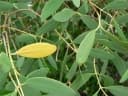
Sonneratia apetala
Sonneratia apetala
Safety & Hazards
None known
Cultivation Details
Sonneratia apetala is a plant of moist coastal areas in the tropics. It succeeds in areas where annual daytime temperatures range between 20 - 30°c, though it tolerates 10 - 35°c[1]. It prefers a mean annual rainfall of 1,650 - 1,800mm, tolerating 1,300 - 3,000mm, and succeeds in areas with no dry season as well as those with a dry season[1, 2]. Requires a sunny position[1]. Grows best in a heavy soil[1]. The plant is usually found in silty-clay to sandt soils in the wild[2]. Plants are very tolerant of saline conditions and maritime winds[2]. Prefers a pH in the range 6.8 - 7.2, tolerating 6.5 - 7.5[1]. If the tree is damaged by strong winds then the crown usually recovers very quickly - if the tree is blown over then it usually recovers quickly by producing coppice shoots[2]. The plant usually starts producing seed when it is around 3 - 4 years old[2]. The flowers are nocturnal, opening in the evening and falling off in the morning.
Propagation
Seed - it has a low viability of less than three months[3]. The mature fruits should be harvested and then kept in sack for two weeks to allow the fleshy mesocarp to rot in order to collect the seeds. The fruits should then be gently crushed and the seeds, along with the debris, should be sown in a nursery bed. Germination usually takes 20 to 30 days. Pot up seedlings into containers of estuarine mud and water regularly. Plant out into permanent positions when around 50cm tall with at least 6 leaves[2]. Cite as: Tropical Plants Database, Ken Fern. tropical.theferns.info. 2026-02-20. <tropical.theferns.info/viewtropical.php?id=Sonneratia+apetala>
Pollinators
Bees
References
- [1]Ecocrop — http://ecocrop.fao.org/ecocrop/srv/en/home ↩︎Basic information on a wide range of useful plants, plus details of environmental needs where available.
- [2]A Monograph on Sonneratia apetala Buch.-Ham. — Nasrin S.; Hossain M. & Alam Md.R. · Lambert Academic Publishing · 2017 · ISBN 978-3-330-05251-2 ↩︎A very detailed look at the environmental and other uses of this species.
- [3]IUCN Red List of Threatened Species — http://www.iucnredlist.org/ ↩︎A list of plants under threat and facing possible extinction, usually with brief details of the threats and information on habitat.
- [4]Flora of China — Missouri Botanical Garden Press; St. Louis. · 1994 · http://flora.huh.harvard.edu/china/ ↩︎An excellent, comprehensive resource in 25 volumes. In addition to the botanical information the flora also gives basic information on habitat and some uses. An on-line version is also available.