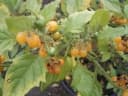
Solanum villosum
Solanum villosum
Safety & Hazards
Although providing many well-known foods for people, including the potato, tomato, pepper and aubergine, most species in this genus also contain toxic alkaloids. Whilst these alkaloids can make the plant useful in treaing a range of medical conditions, they can also cause problems such as nausea, vomiting, salivation, drowsiness, abdominal pain, diarrhoea, weakness and respiratory depression[1]. Unless there are specific entries with information on edible uses, it would be unwise to ingest any part of this plant[PFAF].
Cultivation Details
Solanum villosum occurs from the warm temperate zone to the tropics at elevations from sea-level to about 2,400 metres. The optimum temperature is probably between 20 - 30°c and the plant is intolerant of frost. It performs well during the rainy season, or when irrigated regularly. An annual rainfall of 500 - 1,200mm is suitable[2]. The plant can grow on a wide range of soils, but prefers soils that are rich in organic matter and land covered with ash of recently burnt vegetation[2]. The plant is not resistant to drought[2]. Weeding is important when the plants are young, later the crop suffers little from weeds[2]. Growth of seedlings is fast and flowering starts after 5 - 8 weeks. Under stress, flowering can start even earlier[2]. Vegetative growth slows down with flowering as a result of competition[2]. The plant is self-pollinating and self-compatible and sets fruit easily under favourable environmental conditions. It continues flowering even when it has started fruit set, resulting in plants bearing mature fruits on the lower branches, young ones in the middle and flowers in the top part[2]. The first harvest is expected 4 - 5 weeks after transplanting. Harvesting for the market is done in the late evening or early morning. The stem is cut with a knife or picked by hand about 10cm above the ground. This allows new shoots to form and is done at intervals of 7 - 14 days, allowing 8 - 10 harvests from the stock. When spacing is close (e.g. 10 cm × 10 cm) whole plants are uprooted. Flowers are removed before the produce is taken to the market[2]. In Kenya and Tanzania the annual yield of small-scale farmers is 20 - 25 tonnes of leaves and young shoots per hectare; another report mentions a cumulative yield of edible leaves of 12 - 20 tonnes per hectare per growing season in Kenya[2] Two subspecies of Solanum villosum have been distinguished: subsp. Villosum and subsp. Miniatum (Bernh. Ex Willd.) Edmonds, based on hair density and presence or absence of glands on the hairs and whether the stem is rounded and smooth or angled with toothed ridges. The less hairy subsp. Miniatum is preferred as a vegetable. However, many authors do not recognize these subspecies[2].
Propagation
Seed - sow early spring in a warm greenhouse. When they are large enough to handle, prick the seedlings out into individual pots and plant them out after the last expected frosts. Seed - under optimum conditions of moisture and temperature, the seeds germinate within seven days[2]. Direct sowing is common; commercial farmers often use nurseries. In nurseries the seed is mixed with sand or ash, or sometimes both, to facilitate uniform sowing. The beds are prepared by loosening the soil by hand hoe after application of decomposed manure. The beds are covered with grasses which are burnt to sterilize the soil. This also adds potash to the soil. Seed is broadcast or sown in furrows 15 - 20cm apart. The seeds are covered with a thin layer of soil, but sometimes farmers prefer to leave them open so that they germinate earlier. Especially during the dry season, the beds are covered with tall grasses to maintain soil moisture. The grass is removed when the seedlings are about 3cm tall[2]. Stem cuttings have also been used for propagation[2]. Cite as: Temperate Plants Database, Ken Fern. temperate.theferns.info. 2026-02-21. <temperate.theferns.info/plant/Solanum+villosum>
Pollinators
Self
References
- [1]Poisonous Plants of North Carolina — http://www.ces.ncsu.edu/depts/hort/consumer/poison/poison.htm ↩︎An excellent concise but comprehensive guide to toxic plants that grow in N. Carolina. It lists even those plants that are of very low toxicity, including several well-known food plants such as carrots and potatoes.
- [2]Protabase - Plant Resources of Tropical Africa. — http://www.prota.org ↩︎An excellent on-line database with detailed information on over 3,200 species of useful plants of Africa.
- [3]Flora of Tropical East Africa — Beentje H.J. · Royal Botanic Gardens; Kew. · 2002 · http://plants.jstor.org/search?st=396814 ↩︎Available on-line, a modern flora of East Africa.
- [4]Flora of Turkey. — Davis. P. H. · Edinburgh University Press · 1965 · ISBN - ↩︎Not for the casual reader, this is an immense work in many volumes. Some details of plant uses and habitats.
- [5]Flora of China — Missouri Botanical Garden Press; St. Louis. · 1994 · http://flora.huh.harvard.edu/china/ ↩︎An excellent, comprehensive resource in 25 volumes. In addition to the botanical information the flora also gives basic information on habitat and some uses. An on-line version is also available.
- [PFAF]Plants for a Future — pfaf.org ↩︎