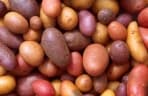
Solanum tuberosum
Solanum tuberosum
Cultivation Details
The potato originated through cultivation from plants being grown at moderate to higher elevations in the tropics of South America. Plants succeed in temperate climates when grown as an annual, the tubers being planted in the spring and harvested in the summer to autumn as growth dies down. In the Tropics plants are rarely grown at elevations lower than 1,000 metres since yields are poor at low elevations[5]. The plant is reported to tolerate an annual precipitation in the range of 90 - 4,100mm, and an annual temperature in the range of 3.6 to 27.8°c[6]. Potatoes are a cool weather crop, the optimal temperature for growth of most cultivars being around 22°c when the plants are young, dropping to around 18°c as the tubers are formed[5]. Growth of the tubers is best at soil temperature of 16 - 20°c, with usually no tubers formed above 30°c[5]. The top-growth of potatoes is not frost hardy, though the tubers will tolerate a few degrees of frost if left in the ground[7]. Succeeds in most soils, preferably in a sunny position[8]. It performs well on a wide variety of soils, sandy loams, silt loams, loams, and peats[6]. Dislikes wet or heavy clay soils[9, 10]. Prefers a slightly acid soil, the tubers are subject to scab on limy soils or those deficient in humus. Prefers a pH in the range 5.2 - 6.0, tolerating 4.2 - 8.3[6, 5]. Yields are best from plants grown in rich soils with plenty of organic matter[5]. Potatoes are very widely grown throughout the world for their edible tubers, there are many named varieties[11]. The potato probably arose through cultivation from several wild species that can still be found growing in S. America. Many of these wild species can be used in breeding programmes for improved disease resistance etc. Potatoes should not be stored with apples because the ethylene gas released by the apples will cause the potatoes to go soft and develop a sour taste[12].
Propagation
Seed - sow early spring in a greenhouse. When they are large enough to handle, prick the seedlings out into individual pots and plant them out into their permanent positions after the last expected frosts. If grown on fast it is possible to get a reasonable crop in the first year though the normal way of growing potatoes is from tubers. Seed from named varieties will not breed true to type but will usually give a good crop. Division of tubers. Harvest in the autumn, store in a cool frost free place overwinter. Chit the potatoes to encourage the growth of sprouts in the new year and plant out in spring. Cite as: Temperate Plants Database, Ken Fern. temperate.theferns.info. 2026-02-21. <temperate.theferns.info/plant/Solanum+tuberosum>
Pollinators
Insects
References
- [1]Encyclopaedia of Medicinal Plants. — Chiej. R. · MacDonald · 1984 · ISBN 0-356-10541-5 ↩︎Covers plants growing in Europe. Also gives other interesting information on the plants. Good photographs.
- [2]Poisonous Plants and Animals. — Altmann. H. · Chatto and Windus · 1980 · ISBN 0-7011-2526-8 ↩︎A small book, reasonable but not very detailed.
- [3]Poisonous Plants. — Stary. F. · Hamlyn · 1983 · ISBN 0-600-35666-3 ↩︎Not very comprehensive, but easy reading.
- [4]A Colour Atlas of Poisonous Plants. — Frohne. D. and Pfänder. J. · Wolfe · 1984 · ISBN 0723408394 ↩︎Brilliant. Goes into technical details but in a very readable way. The best work on the subject that I've come across so far.
- [5]Vegetables in the Tropics — Tindall. H. D. · MacMillan, Oxford. · 1983 · ISBN 0-333-24268-8 ↩︎An excellent, in-depth look at the main vegetable crops that can be grown in the Tropics, plus many less well-known plants.
- [6]Handbook of Energy Crops — Duke. J. · - · 1983 · https://hort.purdue.edu/newcrop/duke_energy/dukeindex.html · ISBN - ↩︎Published only on the Internet, excellent information on a wide range of both temperate and tropical plants.
- [7]The New RHS Dictionary of Gardening. 1992. — Huxley. A. · MacMillan Press · 1992 · ISBN 0-333-47494-5 ↩︎Excellent and very comprehensive, though it contains a number of silly mistakes. Readable yet also very detailed.
- [8]RHS Dictionary of Plants plus Supplement. 1956 — F. Chittendon. · Oxford University Press · 1951 · ISBN - ↩︎Comprehensive listing of species and how to grow them. Somewhat outdated, it has been replaced in 1992 by a new dictionary (see [ 200 ]).
- [9]New Vegetable Growers Handbook. — Simons. · Penguin · 1977 · ISBN 0-14-046-050-0 ↩︎A good guide to growing vegetables in temperate areas, not entirely organic.
- [10]The Gardener's Assistant. — Thompson. B. · Blackie and Son. · 1878 · ISBN - ↩︎Excellent general but extensive guide to gardening practices in the 19th century. A very good section on fruits and vegetables with many little known species.
- [11]Fruits of the Earth. — Bianchini. F., Corbetta. F. and Pistoia. M. ↩︎Lovely pictures, a very readable book.
- [12]A - Z of Companion Planting. — Allardice.P. · Cassell Publishers Ltd. · 1993 · ISBN 0-304-34324-2 ↩︎A well produced and very readable book.
- [13]Cornucopia - A Source Book of Edible Plants. — Facciola. S. · Kampong Publications · 1990 · ISBN 0-9628087-0-9 ↩︎Excellent. Contains a very wide range of conventional and unconventional food plants (including tropical) and where they can be obtained (mainly N. American nurseries but also research institutes and a lot of other nurseries from around the world.
- [14]A Modern Herbal. — Grieve. · Penguin · 1984 · ISBN 0-14-046-440-9 ↩︎Not so modern (1930's?) but lots of information, mainly temperate plants.
- [15]Glossary of Indian Medicinal Plants (Including the Supplement). — Chopra. R. N., Nayar. S. L. and Chopra. I. C. · Council of Scientific and Industrial Research, New Delhi. · 1986 · ISBN - ↩︎Very terse details of medicinal uses of plants with a wide range of references and details of research into the plants chemistry. Not for the casual reader.
- [16]The Encyclopedia of Medicinal Plants — Chevallier. A. · Dorling Kindersley. London · 1996 · ISBN 9-780751-303148 ↩︎An excellent guide to over 500 of the more well known medicinal herbs from around the world.
- [17]Flowers of Europe - A Field Guide. — Polunin. O. · Oxford University Press · 1969 · ISBN 0192176218 ↩︎An excellent and well illustrated pocket guide for those with very large pockets. Also gives some details on plant uses.
- [18]Plants Consumed by Man. — Brouk. B. · Academic Press · 1975 · ISBN 0-12-136450-x ↩︎Readable but not very comprehensive.
- [19]Economic Botany. — Hill. A. F. · The Maple Press · 1952 · ISBN - ↩︎Not very comprehensive, but it is quite readable and goes into some detail about the plants it does cover.
- [20]CosIng — http://ec.europa.eu/growth/tools-databases/cosing/ ↩︎CosIng is the European Commission database for information on cosmetic substances and ingredients.