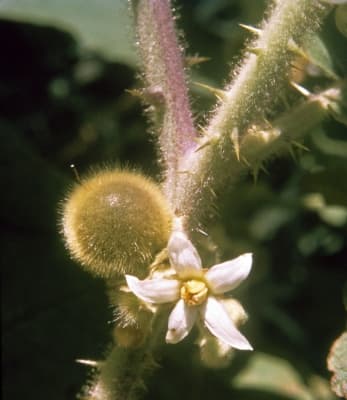
Solanum stramoniifolium
Solanum stramoniifolium
Safety & Hazards
Although providing many well-known foods for people, including the potato, tomato, pepper and aubergine, most species in this genus also contain toxic alkaloids. Whilst these alkaloids can make the plant useful in treaing a range of medical conditions, they can also cause problems such as nausea, vomiting, salivation, drowsiness, abdominal pain, diarrhoea, weakness and respiratory depression[1]. Unless there are specific entries with information on edible uses, it would be unwise to ingest any part of this plant[PFAF].
Cultivation Details
The plant is tolerant of diverse soil types ranging from rich to relatively sterile sandy soils, usually on well drained substrata and not ordinarily found in swampy situations[2]. The plant is often found as a weed within its native range, and is sporadically adventive elsewhere in the tropics[2].
Propagation
Seed - sow in trays in a nursery. Prick out the seedlings into individual pots when they are large enough to handle and grow them on fast. Plant them out when 10cm or more tall. Cuttings of half-ripe wood. Very easy, the cuttings root within a couple of weeks. Cite as: Tropical Plants Database, Ken Fern. tropical.theferns.info. 2026-02-20. <tropical.theferns.info/viewtropical.php?id=Solanum+stramoniifolium>
Pollinators
Insects
References
- [1]Poisonous Plants of North Carolina — http://www.ces.ncsu.edu/depts/hort/consumer/poison/poison.htm ↩︎An excellent concise but comprehensive guide to toxic plants that grow in N. Carolina. It lists even those plants that are of very low toxicity, including several well-known food plants such as carrots and potatoes.
- [2]Solanaceae Source — http://solanaceaesource.org/ ↩︎Incredible detail on all the species in Solanum (now also including the Tomatoes which were formerly in Lycopersicon). The site will eventually include all other Genera within the Solanaceae.
- [3]Useful Plants of the Siona and Secoya Indians of Eastern Ecuador. — Vickers W.T.; Plowman T. · Field Museum of Natural History; USA. · 1984 · http://www.biodiversitylibrary.org · ISBN 0015 - 0746 ↩︎Very terse, but it gives the uses of a large number of species. It can be downloaded from the Internet.
- [4]Botanical Museum Leaflets Vol 28 — Harvard University; Cambridge, Mass. · 1981 · http://www.biodiversitylibrary.org ↩︎An article on the Ethnopharmacological uses of plants in northwestern S. America, amongst many other articles. It can be downloaded from the Internet.
- [5]Enciclopedia de las Plantas Útiles del Ecuador — de la Torre, L., Navarrete H., P. Muriel M., Macía M.J. & Ba · Herbario QCA de la Escuela de Ciencias Biológicas de la Pontific · 2008 · ISBN 978-9978-77-135-8 ↩︎
- [6]CosIng — http://ec.europa.eu/growth/tools-databases/cosing/ ↩︎CosIng is the European Commission database for information on cosmetic substances and ingredients.
- [PFAF]Plants for a Future — pfaf.org ↩︎