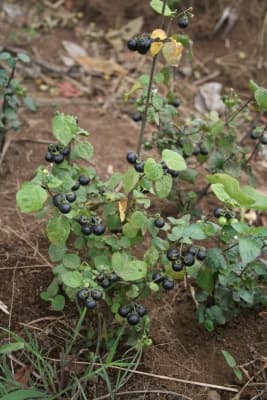
Solanum scabrum
Solanum scabrum
Safety & Hazards
There is a lot of disagreement over whether or not the leaves or fruit of this plant are poisonous. Views vary from relatively poisonous to perfectly safe to eat. The plant is cultivated as a food crop, both for its fruit and its leaves, in some parts of the world and it is probably true to say that toxicity can vary considerably according to where the plant is grown and the cultivar that is being grown[1, 2, 3, 4, 5, 6]. The unripe fruit contains the highest concentration of toxins[5].
Cultivation Details
Solanum scabrum is a plant of garden origin. It succeeds as a short-lived perennial in the tropics from sea level to elevations of 2,000 metres, but in more temperate areas it is grown as an annual[7]. Plants grow best at a temperature in the range 20 - 30°c and a rainfall of 500mm or more[8]. They are intolerant of frost[9]. An easily grown plant, it succeeds in most soils[10], growing best when there is a high content of organic matter in the soil[7]. Sandy loams to friable clay soils with a pH of 6.0 - 6.5 are suitable. Grows best in full sun, but plants tolerate a reasonable level of shade[7]. Intolerant of dry conditions[7]. After seed emergence, growth is fast. The first flowers appear 8 - 11 weeks after sowing[9]. A first harvest of the leaves can take place about 2 - 3 months after sowing the seed[7]. The stems are cut down to about 15cm from the ground, allowing new side shoots to develop. The length of harvested shoot varies from 15 - 50 cm, depending on the cultivar. Further harvests can take place at 7 - 14 day intervals, for up to 10 crops[9]. Yields of 7 - 27 tonnes of shoots per hectare are reported per harvest. Yields decline significantly after the sixth harvest unless adequate fertilizer is applied. Cumulative yields may reach 40 tonnes per hectare[9]. There is at least one named form[11]. Caterpillars and slugs are particularly fond of this plant and can totally destroy it[PFAF].
Propagation
Seed - sow spring in situ. The seed can also be sown in a greenhouse during the spring if required since this will normally produce larger crops of fruit. Prick out the seedlings into individual pots when they are large enough to handle and plant out in late spring. Cite as: Temperate Plants Database, Ken Fern. temperate.theferns.info. 2026-02-21. <temperate.theferns.info/plant/Solanum+scabrum>
Pollinators
Self, Insects
References
- [1]A Modern Herbal. — Grieve. · Penguin · 1984 · ISBN 0-14-046-440-9 ↩︎Not so modern (1930's?) but lots of information, mainly temperate plants.
- [2]Encyclopaedia of Medicinal Plants. — Chiej. R. · MacDonald · 1984 · ISBN 0-356-10541-5 ↩︎Covers plants growing in Europe. Also gives other interesting information on the plants. Good photographs.
- [3]Poisonous Plants and Animals. — Altmann. H. · Chatto and Windus · 1980 · ISBN 0-7011-2526-8 ↩︎A small book, reasonable but not very detailed.
- [4]Hamlyn Encyclopaedia of Plants. — Triska. Dr. · Hamlyn · 1975 · ISBN 0-600-33545-3 ↩︎Very interesting reading, giving some details of plant uses and quite a lot of folk-lore.
- [5]A Colour Atlas of Poisonous Plants. — Frohne. D. and Pfänder. J. · Wolfe · 1984 · ISBN 0723408394 ↩︎Brilliant. Goes into technical details but in a very readable way. The best work on the subject that I've come across so far.
- [6]Poisonous Plants in Britain and their Effects on Animals and Man. — Cooper. M. and Johnson. A. · HMSO · 1984 · ISBN 0112425291 ↩︎Concentrates mainly on the effects of poisonous plants to livestock.
- [7]Vegetables in the Tropics — Tindall. H. D. · MacMillan, Oxford. · 1983 · ISBN 0-333-24268-8 ↩︎An excellent, in-depth look at the main vegetable crops that can be grown in the Tropics, plus many less well-known plants.
- [8]Traditional Vegetables in Benin — Achigan-Dako E. Et al · Darwin Initiative; International Foundation for Science · 2009 ↩︎Issued as a PDF on the Internet, it contains basic information on over 250 species of plants used for food in Benin.
- [9]Protabase - Plant Resources of Tropical Africa. — http://www.prota.org ↩︎An excellent on-line database with detailed information on over 3,200 species of useful plants of Africa.
- [10]RHS Dictionary of Plants plus Supplement. 1956 — F. Chittendon. · Oxford University Press · 1951 · ISBN - ↩︎Comprehensive listing of species and how to grow them. Somewhat outdated, it has been replaced in 1992 by a new dictionary (see [ 200 ]).
- [11]Cornucopia - A Source Book of Edible Plants. — Facciola. S. · Kampong Publications · 1990 · ISBN 0-9628087-0-9 ↩︎Excellent. Contains a very wide range of conventional and unconventional food plants (including tropical) and where they can be obtained (mainly N. American nurseries but also research institutes and a lot of other nurseries from around the world.
- [12]Sturtevant's Edible Plants of the World. — Hedrick. U. P. · Dover Publications · 1972 · ISBN 0-486-20459-6 ↩︎Lots of entries, quite a lot of information in most entries and references.
- [13]The Vegetable Garden. — Vilmorin. A. · Ten Speed Press · ISBN 0-89815-041-8 ↩︎A reprint of a nineteenth century classic, giving details of vegetable varieties. Not really that informative though.
- [14]Flowers of the Mediterranean. — Polunin. O. and Huxley. A. · Hogarth Press · 1987 · ISBN 0-7012-0784-1 ↩︎A very readable pocket flora that is well illustrated. Gives some information on plant uses.
- [15]Famine Foods listed in the Chiu-Huang Pen-ts'ao. — Reid. B. E. · Southern Materials Centre; Taipei · 1977 · ISBN - ↩︎A translation of an ancient Chinese book on edible wild foods. Fascinating.
- [16]Edible Native Plants of the Rocky Mountains. — Harrington. H. D. · University of New Mexico Press · 1967 · ISBN 0-8623-0343-9 ↩︎A superb book. Very readable, it gives the results of the authors experiments with native edible plants.
- [17]Native Edible Plants of New Zealand. — Crowe. A. · Hodder and Stoughton · 1990 · ISBN 0-340-508302 ↩︎A very well written and illustrated book based on the authors own experiments with living on a native diet.
- [18]The New RHS Dictionary of Gardening. 1992. — Huxley. A. · MacMillan Press · 1992 · ISBN 0-333-47494-5 ↩︎Excellent and very comprehensive, though it contains a number of silly mistakes. Readable yet also very detailed.
- [19]The Herb Book. — Lust. J. · Bantam books · 1983 · ISBN 0-553-23827-2 ↩︎Lots of information tightly crammed into a fairly small book.
- [20]Forest Flora of Srinagar. — Singh. Dr. G. and Kachroo. Prof. Dr. P. · Bishen Singh Mahendra Pal Singh · 1976 · ISBN - ↩︎A good flora of the western Himalayas but poorly illustrated. Some information on plant uses.
- [21]A Barefoot Doctors Manual. — ? · Running Press; Philadelphica. · 1977 · ISBN 0-914294-92-X ↩︎A very readable herbal from China, combining some modern methods with traditional chinese methods.
- [22]Narcotic Plants — Emboden. W. · Studio Vista · 1979 · ISBN 0-289-70864-8 ↩︎A lot of details about the history, chemistry and use of narcotic plants, including hallucinogens, stimulants, inebriants and hypnotics.
- [23]Medicinal Plants of China — Duke. J. A. and Ayensu. E. S. · Reference Publications, Inc. · 1985 · ISBN 0-917256-20-4 ↩︎Details of over 1,200 medicinal plants of China and brief details of their uses. Often includes an analysis, or at least a list of constituents. Heavy going if you are not into the subject.
- [PFAF]Plants for a Future — pfaf.org ↩︎