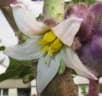
Solanum quitoense
Solanum quitoense
Safety & Hazards
The fruits are covered in stinging hairs, though these are easily removed[1]. Although providing many well-known foods for people, including the potato, tomato, pepper and aubergine, most species in this genus also contain toxic alkaloids. Whilst these alkaloids can make the plant useful in treaing a range of medical conditions, they can also cause problems such as nausea, vomiting, salivation, drowsiness, abdominal pain, diarrhoea, weakness and respiratory depression[2]. Unless there are specific entries with information on edible uses, it would be unwise to ingest any part of this plant[PFAF].
Cultivation Details
Plants can be grown from quite low elevations in the tropics up to an elevation of 2,500 metres or more[3]. They do not do well in hot, lowland tropical areas[4]. They appear to be tolerant of temperatures up to about 30°c[3], but are intolerant of frost[4]. They prefer an annual precipitation of around 1,500mm fairly evenly spread through the year since dry periods can lead to a check in growth[3]. Plants generally prefer a sunny position, but at lowland elevations they will often benefit from light shade[3]. Can succeed in a range of soils so long as they are rich in organic matter[3]. Prefers a light, fertile, well-drained soil[4]. Prefers a pH in the range 6.5 - 7, tolerating 5.8 - 8[5]. Grows best in a position sheltered from strong winds[4]. Introduced into the Galapagos by settlers, it is considered to be invasive there[6]. Seedling plants generally commence fruiting when about 10 - 13 months old[4]. Annual yields of 1 - 2 tonnes of fruit per hectare are obtained[7]. Plants can flower and fruit all year round[4]. The flowers are hermaphrodite and plants are usually self-fertile[4]. The plant is susceptible to attack by nematodes and other pests, limiting its cultivation. In recent years its has been hybridized with various species, especially with S. Sessiliflorum, with the result that most plants grown and served in Ecuador comes from this hybrid. The hybrid can be distinguished from the true lulo by the colour of its fruit pulp: pure Solanum quitoense has bright green fruit pulp, whereas the hybrids most often have yellowish or, at most, light greenish fruit pulp[8].
Propagation
Seed - sow in a seedbed or in containers. Plant out when 10 - 15cm tall[3]. Cite as: Tropical Plants Database, Ken Fern. tropical.theferns.info. 2026-02-20. <tropical.theferns.info/viewtropical.php?id=Solanum+quitoense>
Pollinators
Self, Insects
References
- [1]Brazilian Fruits and Cultivated Exotics — Lorenzi. H.; Bacher. L.; Lacerda. M.; Sartori. S. · Instituto Plantarum De Estudos Da Flora LTDA; Brazil. · 2000 · ISBN 85-867174-24-0 ↩︎A superb book, giving information on several hundred fruit species. Each entry has a brief description of the plant and its uses, accompanied by one to many excellent quality photographs of the fruits.
- [2]Poisonous Plants of North Carolina — http://www.ces.ncsu.edu/depts/hort/consumer/poison/poison.htm ↩︎An excellent concise but comprehensive guide to toxic plants that grow in N. Carolina. It lists even those plants that are of very low toxicity, including several well-known food plants such as carrots and potatoes.
- [3]Vegetables in the Tropics — Tindall. H. D. · MacMillan, Oxford. · 1983 · ISBN 0-333-24268-8 ↩︎An excellent, in-depth look at the main vegetable crops that can be grown in the Tropics, plus many less well-known plants.
- [4]Perennial Edible Fruits of the Tropics : an Inventory — Martin, F. W.; Campbell, C. W.; Rubertbe, R. M. · U.S. Dept. of Agriculture, Agricultural Research Service · 1987 ↩︎A booklet giving terse details of almost 300 species of edible fruits, plus regional lists of Botanical and Common names for over 2,500 less well-known edible fruits of the tropics.
- [5]Ecocrop — http://ecocrop.fao.org/ecocrop/srv/en/home ↩︎Basic information on a wide range of useful plants, plus details of environmental needs where available.
- [6]Pacific Island Ecosystems at Risk — http://www.hear.org/pier/scientificnames/index.html ↩︎A very good website detailing weed species that have been introduced into the Pacific Islands.
- [7]Plant Resources of Southeast Asia — http://proseanet.org/ ↩︎Lots of information on the uses of the plants of SE Asia.
- [8]Solanaceae Source — http://solanaceaesource.org/ ↩︎Incredible detail on all the species in Solanum (now also including the Tomatoes which were formerly in Lycopersicon). The site will eventually include all other Genera within the Solanaceae.
- [9]Dictionary of Economic Plants. — Uphof. J. C. Th. · Weinheim · 1959 · ISBN - ↩︎An excellent and very comprehensive guide but it only gives very short descriptions of the uses without any details of how to utilize the plants. Not for the casual reader.
- [10]Enciclopedia de las Plantas Útiles del Ecuador — de la Torre, L., Navarrete H., P. Muriel M., Macía M.J. & Ba · Herbario QCA de la Escuela de Ciencias Biológicas de la Pontific · 2008 · ISBN 978-9978-77-135-8 ↩︎
- [11]CosIng — http://ec.europa.eu/growth/tools-databases/cosing/ ↩︎CosIng is the European Commission database for information on cosmetic substances and ingredients.
- [PFAF]Plants for a Future — pfaf.org ↩︎