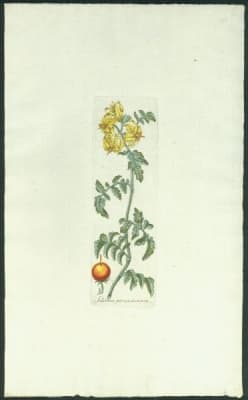
Solanum peruvianum
Solanum peruvianum
Safety & Hazards
All green parts of the plant are poisonous[1]. Although providing many well-known foods for people, including the potato, tomato, pepper and aubergine, most species in this genus also contain toxic alkaloids. Whilst these alkaloids can make the plant useful in treaing a range of medical conditions, they can also cause problems such as nausea, vomiting, salivation, drowsiness, abdominal pain, diarrhoea, weakness and respiratory depression[2]. Unless there are specific entries with information on edible uses, it would be unwise to ingest any part of this plant[PFAF].
Cultivation Details
Solanum peruvianum is native to subtropical and tropical zones of the Andes of northern Chile and central Peru, growing at elevations up to 2,900 metres. Plants are not frost-hardy, but can be grown as an annual in warmer regions of the temperate zone. Requires a rich well-drained soil in a sunny position. The plant can flower and fruit all year round[3]. In cool wet summers the total yields are likely to be low[PFAF]. This species does not hybridize with Solanum lycopersicon[4].
Propagation
Seed - sow early spring in a warm greenhouse. Germination is usually quick and good. Pot up the seedlings into individual pots of fairly rich compost as soon as the first true leaf appears and plant them out after the last expected frosts. Seed can also be sown in situ under a cloche at the end of mid spring, though in a cool summer the results may be disappointing. The seedcoat may carry tomato mosaic virus. However, by sowing the seed 15mm deep the seedcoat will remain below the soil surface when the seed germinates and the disease will be inactivated[5]. Cite as: Temperate Plants Database, Ken Fern. temperate.theferns.info. 2026-02-21. <temperate.theferns.info/plant/Solanum+peruvianum>
Pollinators
Insects, Self
References
- [1]Poisonous Plants in Britain and their Effects on Animals and Man. — Cooper. M. and Johnson. A. · HMSO · 1984 · ISBN 0112425291 ↩︎Concentrates mainly on the effects of poisonous plants to livestock.
- [2]Poisonous Plants of North Carolina — http://www.ces.ncsu.edu/depts/hort/consumer/poison/poison.htm ↩︎An excellent concise but comprehensive guide to toxic plants that grow in N. Carolina. It lists even those plants that are of very low toxicity, including several well-known food plants such as carrots and potatoes.
- [3]Solanaceae Source — http://solanaceaesource.org/ ↩︎Incredible detail on all the species in Solanum (now also including the Tomatoes which were formerly in Lycopersicon). The site will eventually include all other Genera within the Solanaceae.
- [4]The Plant Wealth of Iraq. — Chakravarty. H. L. ↩︎It is surprising how many of these plants can be grown in Britain. A very readable book on the useful plants of Iraq.
- [5]The Garden. Volume 113. — RHS. · Royal Horticultural Society · 1988 · ISBN - ↩︎Snippets of information from the magazine of the RHS, including details on Podophyllum, Canna and Protea species.
- [6]Tanaka's Cyclopedia of Edible Plants of the World. — Tanaka. T. & Nakao S. · Keigaku Publishing; Tokyo · 1976 · ISBN - ↩︎The most comprehensive list of edible plants I've come across. Only the briefest entry for each species, though, and some of the entries are more than a little dubious. Not for the casual reader.
- [7]RHS Dictionary of Plants plus Supplement. 1956 — F. Chittendon. · Oxford University Press · 1951 · ISBN - ↩︎Comprehensive listing of species and how to grow them. Somewhat outdated, it has been replaced in 1992 by a new dictionary (see [ 200 ]).
- [8]The New RHS Dictionary of Gardening. 1992. — Huxley. A. · MacMillan Press · 1992 · ISBN 0-333-47494-5 ↩︎Excellent and very comprehensive, though it contains a number of silly mistakes. Readable yet also very detailed.
- [PFAF]Plants for a Future — pfaf.org ↩︎