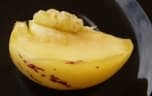
Solanum muricatum
Solanum muricatum
Safety & Hazards
Although providing many well-known foods for people, including the potato, tomato, pepper and aubergine, most species in this genus also contain toxic alkaloids. Whilst these alkaloids can make the plant useful in treaing a range of medical conditions, they can also cause problems such as nausea, vomiting, salivation, drowsiness, abdominal pain, diarrhoea, weakness and respiratory depression[1]. Unless there are specific entries with information on edible uses, it would be unwise to ingest any part of this plant[PFAF].
Cultivation Details
A plant of higher elevations in the moist tropics, able to be grown at low elevations in the subtropics[2]. It is found at elevations up to 4,000 metres[2]. It grows best in areas where annual daytime temperatures are within the range 15 - 25°c, but can tolerate 10 - 30°c[3]. When dormant, the plant can survive temperatures down to about -3°c, but young growth can be severely damaged at 0°c[3]. It prefers a mean annual rainfall in the range 800 - 1,400mm, but tolerates 500 - 2,000mm[3]. Plants are not very hardy in the temperate zone, being cut to the ground even by fairly light frosts. In a warm position and given a good mulch, however, the roots can survive the winter and regrow from the base in the spring. Cuttings are exceedingly easy and these can be overwintered in a greenhouse to provide fresh plants for the following year[PFAF]. Succeeds in most well-drained soils in a sunny position[4, 5]. If the soil is too fertile fruit production will suffer due to excess vegetative growth[5]. Prefers a pH in the range 6.5 - 7, tolerating 6 - 7.5[3]. The plant requires a pH above 6 in order to avoid disorders such as manganese toxicity or iron deficiency[5]. Mature fruits can be harvested about 5 months after planting, and plants can continue to crop for up to two years[2]. Yields of 40 - 60 tonnes per hectare have been achieved[5]. High temperatures, particularly above 30°c, at flowering time can cause the flowers to abort[5]. Plants do not appear to have a sensitivity to day-length[5]. Plants can set fruit parthenocarpically (without fertilization or seed being formed) but self-fertilization or insect fertilization greatly encourages fruiting[5]. Seed is rarely formed in cultivated fruits[2]. There are some named varieties[6, 5].
Propagation
Seed - sow early spring in a warm greenhouse. When they are large enough to handle, prick the seedlings out into individual pots and grow them on in the greenhouse for at least their first winter. Plant them out into their permanent positions in late spring or early summer, after the last expected frosts. Give the plants some protection from the cold for at least their first winter outdoors. Cuttings of half-ripe wood, mid summer in a frame. Very easy. Overwinter in a greenhouse and plant out after the last expected frosts. Cite as: Temperate Plants Database, Ken Fern. temperate.theferns.info. 2026-02-21. <temperate.theferns.info/plant/Solanum+muricatum>
Pollinators
Insects
References
- [1]Poisonous Plants of North Carolina — http://www.ces.ncsu.edu/depts/hort/consumer/poison/poison.htm ↩︎An excellent concise but comprehensive guide to toxic plants that grow in N. Carolina. It lists even those plants that are of very low toxicity, including several well-known food plants such as carrots and potatoes.
- [2]Vegetables in the Tropics — Tindall. H. D. · MacMillan, Oxford. · 1983 · ISBN 0-333-24268-8 ↩︎An excellent, in-depth look at the main vegetable crops that can be grown in the Tropics, plus many less well-known plants.
- [3]Ecocrop — http://ecocrop.fao.org/ecocrop/srv/en/home ↩︎Basic information on a wide range of useful plants, plus details of environmental needs where available.
- [4]RHS Dictionary of Plants plus Supplement. 1956 — F. Chittendon. · Oxford University Press · 1951 · ISBN - ↩︎Comprehensive listing of species and how to grow them. Somewhat outdated, it has been replaced in 1992 by a new dictionary (see [ 200 ]).
- [5]Lost Crops of the Incas — Popenoe. H. et al · National Academy Press · 1990 · ISBN 0-309-04264-X ↩︎An excellent book. Very readable, with lots of information and good pictures of some lesser known food plants of S. America.
- [6]Cornucopia - A Source Book of Edible Plants. — Facciola. S. · Kampong Publications · 1990 · ISBN 0-9628087-0-9 ↩︎Excellent. Contains a very wide range of conventional and unconventional food plants (including tropical) and where they can be obtained (mainly N. American nurseries but also research institutes and a lot of other nurseries from around the world.
- [7]Dictionary of Economic Plants. — Uphof. J. C. Th. · Weinheim · 1959 · ISBN - ↩︎An excellent and very comprehensive guide but it only gives very short descriptions of the uses without any details of how to utilize the plants. Not for the casual reader.
- [8]A Dictionary of Plants Used by Man. — Usher. G. · Constable · 1974 · ISBN 0094579202 ↩︎Forget the sexist title, this is one of the best books on the subject. Lists a very extensive range of useful plants from around the world with very brief details of the uses. Not for the casual reader.
- [9]The New RHS Dictionary of Gardening. 1992. — Huxley. A. · MacMillan Press · 1992 · ISBN 0-333-47494-5 ↩︎Excellent and very comprehensive, though it contains a number of silly mistakes. Readable yet also very detailed.
- [10]CosIng — http://ec.europa.eu/growth/tools-databases/cosing/ ↩︎CosIng is the European Commission database for information on cosmetic substances and ingredients.
- [PFAF]Plants for a Future — pfaf.org ↩︎