Solanum curtilobum
Solanum curtilobum
Safety & Hazards
Although providing many well-known foods for people, including the potato, tomato, pepper and aubergine, most species in this genus also contain toxic alkaloids. Whilst these alkaloids can make the plant useful in treaing a range of medical conditions, they can also cause problems such as nausea, vomiting, salivation, drowsiness, abdominal pain, diarrhoea, weakness and respiratory depression[1]. Unless there are specific entries with information on edible uses, it would be unwise to ingest any part of this plant[PFAF].
Cultivation Details
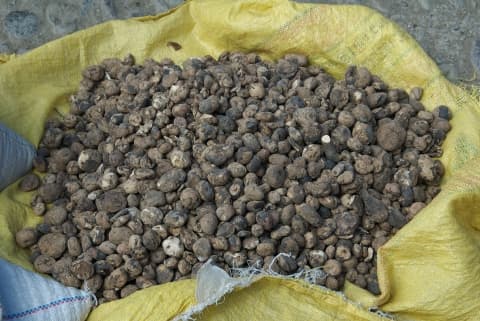
Solanum curtilobum is a plant of high elevations in the tropics, it can also be cultivated at lower elevations in the subtropical and temperate regions. This plant is one of the S. American species of potatoes. It is one of the most frost hardy of the potato species and grows in areas that can experience frosts on 300 days of the year[2]. It can probably be grown in the temperate zone in much the same way as potatoes are grown, by planting out the tubers in spring and harvesting in the autumn[PFAF]. It is sometimes cultivated for its edible tubers in the Andes, mainly as insurance against cold weather[2]. Succeeds in most soils[3]. Dislikes wet or heavy clay soils[4, 5]. Prefers a slightly acid soil, the tubers are subject to scab on limy soils or those deficient in humus. Yields best on a fertile soil rich in organic matter. Yields are quite low[2].Plants might have strict daylength requirements and may yield poorly in temperate zones because they need short-days in order to induce tuber-formation[2]. A pentaploid species, it produces fertile seed[2].
Propagation
Seed - sow early spring in a warm greenhouse. Prick out the seedlings into a fairly rich compost as soon as they are large enough to handle and grow them on fast. Plant them out after the last expected frosts. Division. Harvest the tubers in autumn after the top-growth has been cut back by frost. Store the tubers in a cool frost-free place overwinter and replant in mid spring. Cite as: Temperate Plants Database, Ken Fern. temperate.theferns.info. 2026-02-21. <temperate.theferns.info/plant/Solanum+curtilobum>
Pollinators
Data unavailable
References
- [1]Poisonous Plants of North Carolina — http://www.ces.ncsu.edu/depts/hort/consumer/poison/poison.htm ↩︎An excellent concise but comprehensive guide to toxic plants that grow in N. Carolina. It lists even those plants that are of very low toxicity, including several well-known food plants such as carrots and potatoes.
- [2]Lost Crops of the Incas — Popenoe. H. et al · National Academy Press · 1990 · ISBN 0-309-04264-X ↩︎An excellent book. Very readable, with lots of information and good pictures of some lesser known food plants of S. America.
- [3]RHS Dictionary of Plants plus Supplement. 1956 — F. Chittendon. · Oxford University Press · 1951 · ISBN - ↩︎Comprehensive listing of species and how to grow them. Somewhat outdated, it has been replaced in 1992 by a new dictionary (see [ 200 ]).
- [4]New Vegetable Growers Handbook. — Simons. · Penguin · 1977 · ISBN 0-14-046-050-0 ↩︎A good guide to growing vegetables in temperate areas, not entirely organic.
- [5]The Gardener's Assistant. — Thompson. B. · Blackie and Son. · 1878 · ISBN - ↩︎Excellent general but extensive guide to gardening practices in the 19th century. A very good section on fruits and vegetables with many little known species.
- [6]Solanaceae Source — http://solanaceaesource.org/ ↩︎Incredible detail on all the species in Solanum (now also including the Tomatoes which were formerly in Lycopersicon). The site will eventually include all other Genera within the Solanaceae.
- [7]Plants for Human Consumption. — Kunkel. G. · Koeltz Scientific Books · 1984 · ISBN 3874292169 ↩︎An excellent book for the dedicated. A comprehensive listing of Latin names with a brief list of edible parts.
- [8]Cornucopia II — Facciola. S. · Kampong Publications, California. · 1998 · ISBN 0-9628087-2-5 ↩︎The second edition of an excellent guide to the edible uses of plants, though it does not give any details of cultivation etc.
- [PFAF]Plants for a Future — pfaf.org ↩︎