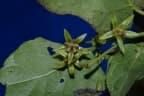
Solanum cajanumense
Solanum cajanumense
Safety & Hazards
The unripe fruit is slightly toxic. Although providing many well-known foods for people, including the potato, tomato, pepper and aubergine, most species in this genus also contain toxic alkaloids. Whilst these alkaloids can make the plant useful in treaing a range of medical conditions, they can also cause problems such as nausea, vomiting, salivation, drowsiness, abdominal pain, diarrhoea, weakness and respiratory depression[1]. Unless there are specific entries with information on edible uses, it would be unwise to ingest any part of this plant[PFAF].
Cultivation Details
A plant of higher elevations in the moist tropics. Plants fruit best with cool temperatures in the growing season[2]. Plants are damaged by temperatures of -1°c or lower Succeeds in a sunny position in any well-drained soil[2]. Prefers a light fertile soil[2]. Dislikes drought[2]. Plants are shallow-rooted and so are very prone to wind damage[2]. A very fast growing plant, it starts to fruit within two years from seed and reaches peak production in 3 - 4 years[2]. Trees are, however, short-lived and start to degenerate after about 8 years[2]. Plants usually ripe their fruit over a period of time, though pruning methods can be used to produce a peak time of fruiting[2]. Plants are probably insensitive to day-length[2]. This species could be a valuable source of gene material for qualities such as nematode resistance, root rot resistance, fragrance, flavour, colour and yield[2]. Plants have a shallow spreading root system and resent surface hoeing, they are best given a good mulch[2]. The leaves have a pungent smell[2]. Plants are subject to attacks by red spider mites.
Propagation
Seed - sow spring in a greenhouse. The seed usually germinates within 4 weeks at 15°c[PFAF], within 2 weeks at 25°c[3]. When they are large enough to handle, prick the seedlings out into individual pots and grow them on in the greenhouse for at least their first winter. Plant them out into their permanent positions in late spring or early summer, after the last expected frosts. Cuttings of greenwood in a frame[4]. Cite as: Temperate Plants Database, Ken Fern. temperate.theferns.info. 2026-02-21. <temperate.theferns.info/plant/Solanum+cajanumense>
Pollinators
Insects, Self
References
- [1]Poisonous Plants of North Carolina — http://www.ces.ncsu.edu/depts/hort/consumer/poison/poison.htm ↩︎An excellent concise but comprehensive guide to toxic plants that grow in N. Carolina. It lists even those plants that are of very low toxicity, including several well-known food plants such as carrots and potatoes.
- [2]Lost Crops of the Incas — Popenoe. H. et al · National Academy Press · 1990 · ISBN 0-309-04264-X ↩︎An excellent book. Very readable, with lots of information and good pictures of some lesser known food plants of S. America.
- [3]Growing from Seed. Volume 4. — Bird. R. (Editor) · Thompson and Morgan. · 1990 · ISBN - ↩︎Very readable magazine with lots of information on propagation. A good article on Yuccas, one on Sagebrush (Artemesia spp) and another on Chaerophyllum bulbosum.
- [4]The New RHS Dictionary of Gardening. 1992. — Huxley. A. · MacMillan Press · 1992 · ISBN 0-333-47494-5 ↩︎Excellent and very comprehensive, though it contains a number of silly mistakes. Readable yet also very detailed.
- [5]Solanaceae Source — http://solanaceaesource.org/ ↩︎Incredible detail on all the species in Solanum (now also including the Tomatoes which were formerly in Lycopersicon). The site will eventually include all other Genera within the Solanaceae.
- [6]Food Plants in the Americas: A Survey of the Domesticated, Cultivated, and Wild Plants Used for Human Food in North, — Kermath B.M.; Bennett B.C.' Pulsipher L.M. · 2014 ↩︎A pre-publication draft of an amazing, on-going work first started in 1985. It contains information on more than 3,900 taxa from the Americas - from Arctic regions to the Tropics
- [7]Enciclopedia de las Plantas Útiles del Ecuador — de la Torre, L., Navarrete H., P. Muriel M., Macía M.J. & Ba · Herbario QCA de la Escuela de Ciencias Biológicas de la Pontific · 2008 · ISBN 978-9978-77-135-8 ↩︎
- [8]Cornucopia II — Facciola. S. · Kampong Publications, California. · 1998 · ISBN 0-9628087-2-5 ↩︎The second edition of an excellent guide to the edible uses of plants, though it does not give any details of cultivation etc.
- [PFAF]Plants for a Future — pfaf.org ↩︎