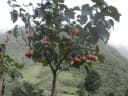
Solanum betaceum
Solanum betaceum
Safety & Hazards
The unripe fruit is slightly toxic[1]. Although providing many well-known foods for people, including the potato, tomato, pepper and aubergine, most species in this genus also contain toxic alkaloids. Whilst these alkaloids can make the plant useful in treaing a range of medical conditions, they can also cause problems such as nausea, vomiting, salivation, drowsiness, abdominal pain, diarrhoea, weakness and respiratory depression[2]. Unless there are specific entries with information on edible uses, it would be unwise to ingest any part of this plant[PFAF].
Cultivation Details
Plants grow best at low elevations in the subtropics and medium to higher elevations in the tropics, where they can succeed at elevations up to 2,800 metres. They grow best in areas where annual daytime temperatures are within the range 16 - 22°c, but can tolerate 10 - 30°c[3, 4]. They can be killed by temperatures of -2°c or lower[4]. They prefer a mean annual rainfall in the range 2,000 - 2,600mm, but tolerate 600 - 4,000mm[3, 4]. Plants are probably insensitive to day-length[3]. Succeeds in a sunny position in any well-drained soil[3, 1]. Prefers a light, mildly acid, fertile soil[3, 5]. Prefers a pH in the range 6.3 - 7, tolerating 5.8 - 7.5[4]. Dislikes drought[3]. Plants are very prone to wind damage[3]. Plants have a shallow spreading root system and resent surface hoeing, they are best given a good mulch[3]. A very fast growing plant, it starts to fruit within two years from seed[1] and reaches peak production in 3 - 4 years[3]. Trees are, however, short-lived - the life of a commercial plantation is about 8 years[3]. Plants grow, flower and fruit best in areas where there is a distinct cooling of a night time - the fruit also develop a better flavour[6]. Plants usually ripen their fruit over a period of time, though pruning methods can be used to produce a peak time of fruiting[3]. Trees can flower and fruit all year round[7]. Yields of about 20 kilos of fruit per tree per year, equating to 15 - 17 tonnes per hectare, are achieved in New Zealand[3]. There are some named varieties[8]. This species does not hybridize easily with other members of the genus[3]. The leaves are large and have a pungent smell[3, 4]. Plants are subject to attacks by red spider mites.
Propagation
Seed - sow spring in a greenhouse. The seed usually germinates within 4 weeks at 15°c[PFAF], within 2 weeks at 25°c[9]. When they are large enough to handle, prick the seedlings out into individual pots and grow them on in the greenhouse for at least their first winter. Plant them out into their permanent positions in late spring or early summer, after the last expected frosts. Cuttings of greenwood in a frame[1]. Cite as: Temperate Plants Database, Ken Fern. temperate.theferns.info. 2026-02-21. <temperate.theferns.info/plant/Solanum+betaceum>
Pollinators
Insects, Self, Wind
References
- [1]The New RHS Dictionary of Gardening. 1992. — Huxley. A. · MacMillan Press · 1992 · ISBN 0-333-47494-5 ↩︎Excellent and very comprehensive, though it contains a number of silly mistakes. Readable yet also very detailed.
- [2]Poisonous Plants of North Carolina — http://www.ces.ncsu.edu/depts/hort/consumer/poison/poison.htm ↩︎An excellent concise but comprehensive guide to toxic plants that grow in N. Carolina. It lists even those plants that are of very low toxicity, including several well-known food plants such as carrots and potatoes.
- [3]Lost Crops of the Incas — Popenoe. H. et al · National Academy Press · 1990 · ISBN 0-309-04264-X ↩︎An excellent book. Very readable, with lots of information and good pictures of some lesser known food plants of S. America.
- [4]Ecocrop — http://ecocrop.fao.org/ecocrop/srv/en/home ↩︎Basic information on a wide range of useful plants, plus details of environmental needs where available.
- [5]Perennial Edible Fruits of the Tropics : an Inventory — Martin, F. W.; Campbell, C. W.; Rubertbe, R. M. · U.S. Dept. of Agriculture, Agricultural Research Service · 1987 ↩︎A booklet giving terse details of almost 300 species of edible fruits, plus regional lists of Botanical and Common names for over 2,500 less well-known edible fruits of the tropics.
- [6]World Agroforesty Centre — http://www.worldagroforestry.org/ ↩︎An excellent online database of a huge range of trees giving very good information on each plant - its uses, ecology, identity, propagation, pests etc.
- [7]Solanaceae Source — http://solanaceaesource.org/ ↩︎Incredible detail on all the species in Solanum (now also including the Tomatoes which were formerly in Lycopersicon). The site will eventually include all other Genera within the Solanaceae.
- [8]Cornucopia - A Source Book of Edible Plants. — Facciola. S. · Kampong Publications · 1990 · ISBN 0-9628087-0-9 ↩︎Excellent. Contains a very wide range of conventional and unconventional food plants (including tropical) and where they can be obtained (mainly N. American nurseries but also research institutes and a lot of other nurseries from around the world.
- [9]Growing from Seed. Volume 4. — Bird. R. (Editor) · Thompson and Morgan. · 1990 · ISBN - ↩︎Very readable magazine with lots of information on propagation. A good article on Yuccas, one on Sagebrush (Artemesia spp) and another on Chaerophyllum bulbosum.
- [10]Dictionary of Economic Plants. — Uphof. J. C. Th. · Weinheim · 1959 · ISBN - ↩︎An excellent and very comprehensive guide but it only gives very short descriptions of the uses without any details of how to utilize the plants. Not for the casual reader.
- [11]A Dictionary of Plants Used by Man. — Usher. G. · Constable · 1974 · ISBN 0094579202 ↩︎Forget the sexist title, this is one of the best books on the subject. Lists a very extensive range of useful plants from around the world with very brief details of the uses. Not for the casual reader.
- [12]Conservatory and Indoor Plants Volumes 1 & 2 — Phillips. R. & Rix. M. · Pan Books, London. · 1998 · ISBN 0-330-37376-5 ↩︎Excellent photos of over 1,100 species and cultivars with habits and cultivation details plus a few plant uses. Many species are too tender for outdoors in Britain though there are many that can be grown outside.
- [13]Growing Unusual Fruit. — Simmons. A. E. · David & Charles; Newton Abbot. · 1972 · ISBN 0-7153-5531-7 ↩︎A very readable book with information on about 100 species that can be grown in Britain (some in greenhouses) and details on how to grow and use them.
- [14]Enciclopedia de las Plantas Útiles del Ecuador — de la Torre, L., Navarrete H., P. Muriel M., Macía M.J. & Ba · Herbario QCA de la Escuela de Ciencias Biológicas de la Pontific · 2008 · ISBN 978-9978-77-135-8 ↩︎
- [PFAF]Plants for a Future — pfaf.org ↩︎