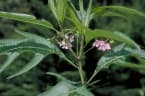
Solanum aviculare
Solanum aviculare
Cultivation Details
Solanum aviculare is found from the warm temperate zone to usually higher elevations in the tropical zone. It grows in regions that experience hot summers and mild winters - it can be grown in other parts of the temperate zone with mild winters but generally also requires hot summers to ripen its wood if it is to survive the winter. It can tolerate temperatures down to at least -7°c in Australian gardens[4]. In areas near its climatic tolerance, it can often be grown successfully at the foot of a warm sunny wall and be treated as a herbaceous perennial. As long as the roots are given a good mulch in autumn they should survive quite cold winters[5, 6]. Alternatively, it is possible to grow the plant as an annual. If the seed is sown in early spring in a warm greenhouse and planted out after the last frosts it can fruit in its first year though yields will be lower than from plants grown as perennials[PFAF]. A very ornamental plant[5], it has been cultivated for its edible fruit by the New Zealand Maoris[7]. Succeeds in most fertile soils in a sunny position[8]. A fast-growing but short-lived plant[9].
Propagation
Seed - sow spring in a warm greenhouse. Germinates in 2 - 3 weeks at 20°c. Prick out the seedlings into individual pots when they are large enough to handle. If growing the plants as annuals, plant them out after the last expected frosts and give them some protection such as a cloche until they are growing well. If growing as a perennial, especially in areas at the limits of its cold-hardiness, it will probably be better to grow the plants on in the greenhouse for their first winter. Give them fairly large pots (12cm or larger) because they have very strong root growth. Top growth might die back over winter, but the roots should survive if temperatures in the greenhouse do not fall below about -5°c. Plant them out in early summer of the following year. The plants will be somewhat hardier in their second winter. Cuttings of half-ripe wood, mid summer in a frame. Very easy, the cuttings root within a couple of weeks. Pot them up in fairly large pots and overwinter them in the greenhouse before planting out in early summer. Cite as: Temperate Plants Database, Ken Fern. temperate.theferns.info. 2026-02-21. <temperate.theferns.info/plant/Solanum+aviculare>
Pollinators
Insects
References
- [1]Flora of Victoria. — Ewart. A. J. · University Press; Melbourne · 1930 ↩︎A flora of eastern Australia, it is rather short on information that is useful to the plant project.
- [2]Native Edible Plants of New Zealand. — Crowe. A. · Hodder and Stoughton · 1990 · ISBN 0-340-508302 ↩︎A very well written and illustrated book based on the authors own experiments with living on a native diet.
- [3]Protabase - Plant Resources of Tropical Africa. — http://www.prota.org ↩︎An excellent on-line database with detailed information on over 3,200 species of useful plants of Africa.
- [4]Australian Native Plants. — Wrigley. J. W. and Fagg. M. · Collins. (Australia) · 1988 · ISBN 0-7322-0021-0 ↩︎A lovely book, written in order to encourage Australian gardeners to grow their native plants. A little bit of information for the plant project.
- [5]RHS Dictionary of Plants plus Supplement. 1956 — F. Chittendon. · Oxford University Press · 1951 · ISBN - ↩︎Comprehensive listing of species and how to grow them. Somewhat outdated, it has been replaced in 1992 by a new dictionary (see [ 200 ]).
- [6]The Milder Garden. — Taylor. J. · Dent · 1990 ↩︎A good book on plants that you didn't know could be grown outdoors in Britain.
- [7]Economic Native Plants of New Zealand. — Brooker. S. G., Cambie. R. C. and Cooper. R. C. · Oxford University Press · 1991 · ISBN 0-19-558229-2 ↩︎An interesting and readable book on the useful plants of New Zealand.
- [8]Ornamental Shrubs, Climbers and Bamboos. — Thomas. G. S. · Murray · 1992 · ISBN 0-7195-5043-2 ↩︎Contains a wide range of plants with a brief description, mainly of their ornamental value but also usually of cultivation details and varieties.
- [9]Wild Food Plants of Australia. — Low. T. · Angus and Robertson. · 1989 · ISBN 0-207-14383-8 ↩︎Well presented, clear information and good photographs. An interesting read for the casual reader as well as the enthusiast
- [10]Solanaceae Source — http://solanaceaesource.org/ ↩︎Incredible detail on all the species in Solanum (now also including the Tomatoes which were formerly in Lycopersicon). The site will eventually include all other Genera within the Solanaceae.
- [11]Flora of New Zealand. — Allan. H. H. · Government Printer, Wellington. · 1961 · http://floraseries.landcareresearch.co.nz/pages/Book.aspx?fileName=Flora%201.xml · ISBN - ↩︎The standard work, in 5 volumes though only the first two are of interest to the plant project. Very good on habitats. There is also an on-line version.
- [12]Australian Tropical Rainforest Plants — http://www.anbg.gov.au/cpbr/cd-keys/rfk/index.html ↩︎An online resource giving botanical information, and a little bit about plant usage, for over 2,700 species of plants found in the Australian rainforest.
- [13]Tanaka's Cyclopedia of Edible Plants of the World. — Tanaka. T. & Nakao S. · Keigaku Publishing; Tokyo · 1976 · ISBN - ↩︎The most comprehensive list of edible plants I've come across. Only the briefest entry for each species, though, and some of the entries are more than a little dubious. Not for the casual reader.
- [14]Sturtevant's Edible Plants of the World. — Hedrick. U. P. · Dover Publications · 1972 · ISBN 0-486-20459-6 ↩︎Lots of entries, quite a lot of information in most entries and references.
- [15]Dictionary of Economic Plants. — Uphof. J. C. Th. · Weinheim · 1959 · ISBN - ↩︎An excellent and very comprehensive guide but it only gives very short descriptions of the uses without any details of how to utilize the plants. Not for the casual reader.
- [16]A Dictionary of Plants Used by Man. — Usher. G. · Constable · 1974 · ISBN 0094579202 ↩︎Forget the sexist title, this is one of the best books on the subject. Lists a very extensive range of useful plants from around the world with very brief details of the uses. Not for the casual reader.
- [17]Cornucopia - A Source Book of Edible Plants. — Facciola. S. · Kampong Publications · 1990 · ISBN 0-9628087-0-9 ↩︎Excellent. Contains a very wide range of conventional and unconventional food plants (including tropical) and where they can be obtained (mainly N. American nurseries but also research institutes and a lot of other nurseries from around the world.
- [18]Mansfeld's Database of Agricultural and Horticultural Plants — http://mansfeld.ipk-gatersleben.de/pls/htmldb_pgrc/f?p=185:3:4292127278597336 ↩︎Terse details of a huge range of useful plants.
- [19]CosIng — http://ec.europa.eu/growth/tools-databases/cosing/ ↩︎CosIng is the European Commission database for information on cosmetic substances and ingredients.
- [PFAF]Plants for a Future — pfaf.org ↩︎