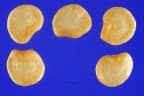
Solanum americanum
Solanum americanum
Safety & Hazards
The bitterness of the plant is associated with a high content of the glycoalkaloid solanine, which is found throughout the plant with the highest concentration in the unripe fruits[1]. In the leaves the concentration increases with age. Solanine is poisonous and only partially soluble in water. Eating a large amount of this vegetable has been associated with diarrhoea and cardiac arrest[1]. The immature fruit is poisonous[2].
Cultivation Details
Solanum americanum is a plant of the tropics and subtropics, it can also be cultivated in the temperate zone. It is found at elevations up to 2,000 metres in the tropics. It grows best in areas where annual daytime temperatures are within the range 20 - 35°c, but can tolerate 15 - 40°c[3]. It prefers a mean annual rainfall in the range 500 - 1,200mm, but tolerates 400 - 1,500mm[3]. Prefers a sunny position but is tolerant of light shade[3]. Succeeds in most soils[4]. Leaf production is best in a fertile soil[1]. Plants can escape from cultivation and become a weed[3]. Young seedlings grow away quickly and can start flowering about two months after germination[1]. The plant continues to develop new flowers for several months[1]. Leaves and stem tops are collected from plants in the wild, or from fields during the rainy season. Harvesting is normally done in the early morning. The main shoot or side shoots are plucked before flowering, leaving at least 5 cm of stem for the production of new side shoots. This method allows 6 - 8 times harvests from the same plant[1]. Although no accurate records are available, the yield is probably comparable to that of S. Villosum and S. Tarderemotum since the plant structure and size, and the harvesting method are comparable. The yield can therefore be estimated at 10 - 20 t/ha, but with adequate management up to 50 t/ha would be feasible[1]. Some superior plants are often not harvested but are left for seed production[1]. The plant is normally self-pollinating, but cross-pollination is possible by insects, mainly bees and syrphid flies[1].
Propagation
Seed - sow spring in a greenhouse. When they are large enough to handle, prick the seedlings out into individual pots and plant them out after the last expected frosts. Cite as: Temperate Plants Database, Ken Fern. temperate.theferns.info. 2026-02-21. <temperate.theferns.info/plant/Solanum+americanum>
Pollinators
Self, Insects
References
- [1]Protabase - Plant Resources of Tropical Africa. — http://www.prota.org ↩︎An excellent on-line database with detailed information on over 3,200 species of useful plants of Africa.
- [2]Native Edible Plants of New Zealand. — Crowe. A. · Hodder and Stoughton · 1990 · ISBN 0-340-508302 ↩︎A very well written and illustrated book based on the authors own experiments with living on a native diet.
- [3]Ecocrop — http://ecocrop.fao.org/ecocrop/srv/en/home ↩︎Basic information on a wide range of useful plants, plus details of environmental needs where available.
- [4]RHS Dictionary of Plants plus Supplement. 1956 — F. Chittendon. · Oxford University Press · 1951 · ISBN - ↩︎Comprehensive listing of species and how to grow them. Somewhat outdated, it has been replaced in 1992 by a new dictionary (see [ 200 ]).
- [5]Gray's Manual of Botany.Eighth Edition — Fernald. M. L. · American Book Co.; New York · 1950 · ISBN 0442222505 ↩︎A bit dated but a good and concise flora of the eastern part of N. America.
- [6]Flora of China — Missouri Botanical Garden Press; St. Louis. · 1994 · http://flora.huh.harvard.edu/china/ ↩︎An excellent, comprehensive resource in 25 volumes. In addition to the botanical information the flora also gives basic information on habitat and some uses. An on-line version is also available.
- [7]Food Plants in the Americas: A Survey of the Domesticated, Cultivated, and Wild Plants Used for Human Food in North, — Kermath B.M.; Bennett B.C.' Pulsipher L.M. · 2014 ↩︎A pre-publication draft of an amazing, on-going work first started in 1985. It contains information on more than 3,900 taxa from the Americas - from Arctic regions to the Tropics
- [8]Medicinal Plants of the Guianas — DeFilipps, R. A.; Maina, S. L.; & Crepin, J. · Smithsonian Museum · http://botany.si.edu/bdg/medicinal/index.html ↩︎A down-loadable PDF document of a book in pre-publication awaiting illustration. An excellent, if rather terse, guide to the traditional medicinal uses of the plants of the region