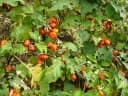
Solanum aethiopicum
Solanum aethiopicum
Safety & Hazards
Although providing many well-known foods for people, including the potato, tomato, pepper and aubergine, most species in this genus also contain toxic alkaloids. Whilst these alkaloids can make the plant useful in treaing a range of medical conditions, they can also cause problems such as nausea, vomiting, salivation, drowsiness, abdominal pain, diarrhoea, weakness and respiratory depression[1]. Unless there are specific entries with information on edible uses, it would be unwise to ingest any part of this plant[PFAF].
Cultivation Details
A plant of the moist tropics, it can also be grown as an annual crop in the temperate zone as long as it can be given a growing season of at least 4 months. It grows best in areas where annual daytime temperatures are within the range 20 - 30°c, but can tolerate 10 - 40°c[2]. It is not tolerant of frosts[2]. It prefers a mean annual rainfall in the range 1,200 - 1,600mm, but tolerates 800 - 4,000mm[2]. An easily grown plant, it succeeds in most moderately fertile, well-drained soils when growing in a sunny position[3]. A soil too rich in nitrogen will encourage leaf growth at the expense of flowering, and so will reduce the yield of fruit[2]. Prefers a pH in the range 5.5 - 7, tolerating 4.3 - 8.5[2]. Young plants grow rapidly and flowering starts from 40 - 100 days after sowing. As the first flowers are initiated, branching and subsequent production of smaller leaves occurs[4]. Growth and flowering may continue indefinitely, but are suppressed once sufficient fruits have set[4]. The preferred weight for fruits of Gilo Group and Kumba Group is 30 - 40g. One plant may produce from 500 g to about 8 kg of fruits, depending on the cultivar and growing conditions[4]. Without irrigation, yields are 5 - 8 t/ha, and with irrigation 12 - 20 t/ha. Improved cultivars grown under favourable conditions may yield 50 - 80 t/ha[4]. Fruits of Kumba Group have mean weights of 70 - 120 g, sometimes even over 200 g; yield is 10 - 20 t/ha[4]. Under good management, farmers growing cultivars of Shum Group can get up to 75 leaf bundles of 30 kg each per 100 m2. This means that the crop has a yield potential of 225 t/ha. The average leaf yield during the dry season for a once-over harvest, however, is only 30 t/ha[4]. This is a food crop that is difficult to characterize as a whole, with a great plasticity and grown in a variety of habitats ranging from dry rocky outcrops and grasslands to forests[5]. Because of their morphological diversity, various cultivars of S. Aethiopicum have previously been described as many different species, and have been confused with S. Incanum and other species. Four cultivar-groups are now recognised, as follows:- S. Aethiopicum Gilo Group. The fruits, which are like hens' eggs or many other shapes and sizes, and scarlet when ripe, are eaten unripe, cooked in stews or even raw[6]. Plants in this group thrive in full sun in woodland savannah on fairly deep and well-drained soils with pH 5.5 - 6.8, and in temperatures of 25 - 35°c during the day and 20 - 27°c at night[4]. S. Aethiopicum Shum Group. Grown in tropical Africa, especially in Cameroon and Uganda. The glabrous small-leaved shoots are cooked as spinach. This group thrives under warm, humid conditions and will drop their leaves when it gets dry. In Uganda they are grown in drying swamps during the dry season[4]. S. Aethiopicum Kumba Group. Grown in sub-Sahelian W Africa, especially Senegal, in the wet season. The large glabrous leaves are cooked as spinach: subsequently the large, sweet, ribbed fruits are eaten raw or cooked in stews[6]. This group thrives in very hot conditions, with temperatures up to 45°c during the day and air humidity sometimes as low as 20%, especially if they are irrigated[4]. S. Aethiopicum Aculeatum Group. These prickly ornamental plants with attractive but very bitter scarlet fruits possess some disease resistance so they are used for breeding and as rootstocks for S. Melongena in Japan[6]. There are some named varieties in in Shum and Gilo groups[7]. The bitter and small-fruited, prickly and hairy ancestor, S. Anguivi occurs throughout tropical Africa[6]. Slugs really love the young plants and will totally destroy them if given half a chance[PFAF].
Propagation
Seed - sow spring in a greenhouse. Germination takes 5 - 9 days for the Gilo and Shum Groups, but only 3 - 5 days for the Kumba Group, although the latter may show seed dormancy and tends to have few seeds per fruit[4]. Prick out the seedlings into individual pots once they are large enough to handle and plant them out after the last expected frosts. Consider giving some protection, such as a cloche, until the plants are growing away strongly[PFAF]. Cite as: Temperate Plants Database, Ken Fern. temperate.theferns.info. 2026-02-21. <temperate.theferns.info/plant/Solanum+aethiopicum>
Pollinators
Bees, Insects
References
- [1]Poisonous Plants of North Carolina — http://www.ces.ncsu.edu/depts/hort/consumer/poison/poison.htm ↩︎An excellent concise but comprehensive guide to toxic plants that grow in N. Carolina. It lists even those plants that are of very low toxicity, including several well-known food plants such as carrots and potatoes.
- [2]Ecocrop — http://ecocrop.fao.org/ecocrop/srv/en/home ↩︎Basic information on a wide range of useful plants, plus details of environmental needs where available.
- [3]RHS Dictionary of Plants plus Supplement. 1956 — F. Chittendon. · Oxford University Press · 1951 · ISBN - ↩︎Comprehensive listing of species and how to grow them. Somewhat outdated, it has been replaced in 1992 by a new dictionary (see [ 200 ]).
- [4]Protabase - Plant Resources of Tropical Africa. — http://www.prota.org ↩︎An excellent on-line database with detailed information on over 3,200 species of useful plants of Africa.
- [5]Flora Zambesiaca — http://apps.kew.org/efloras/fz/intro.html ↩︎An excellent online flora of plants from the Zambezi River basin. It lists a number of the plant uses as well as the habitats and botanical descriptions of the plants.
- [6]Mansfeld's Database of Agricultural and Horticultural Plants — http://mansfeld.ipk-gatersleben.de/pls/htmldb_pgrc/f?p=185:3:4292127278597336 ↩︎Terse details of a huge range of useful plants.
- [7]Vegetables in the Tropics — Tindall. H. D. · MacMillan, Oxford. · 1983 · ISBN 0-333-24268-8 ↩︎An excellent, in-depth look at the main vegetable crops that can be grown in the Tropics, plus many less well-known plants.
- [8]Dictionary of Economic Plants. — Uphof. J. C. Th. · Weinheim · 1959 · ISBN - ↩︎An excellent and very comprehensive guide but it only gives very short descriptions of the uses without any details of how to utilize the plants. Not for the casual reader.
- [9]A Dictionary of Plants Used by Man. — Usher. G. · Constable · 1974 · ISBN 0094579202 ↩︎Forget the sexist title, this is one of the best books on the subject. Lists a very extensive range of useful plants from around the world with very brief details of the uses. Not for the casual reader.
- [10]Sturtevant's Edible Plants of the World. — Hedrick. U. P. · Dover Publications · 1972 · ISBN 0-486-20459-6 ↩︎Lots of entries, quite a lot of information in most entries and references.
- [11]Tanaka's Cyclopedia of Edible Plants of the World. — Tanaka. T. & Nakao S. · Keigaku Publishing; Tokyo · 1976 · ISBN - ↩︎The most comprehensive list of edible plants I've come across. Only the briefest entry for each species, though, and some of the entries are more than a little dubious. Not for the casual reader.
- [12]Food Plants in the Americas: A Survey of the Domesticated, Cultivated, and Wild Plants Used for Human Food in North, — Kermath B.M.; Bennett B.C.' Pulsipher L.M. · 2014 ↩︎A pre-publication draft of an amazing, on-going work first started in 1985. It contains information on more than 3,900 taxa from the Americas - from Arctic regions to the Tropics
- [13]Cornucopia - A Source Book of Edible Plants. — Facciola. S. · Kampong Publications · 1990 · ISBN 0-9628087-0-9 ↩︎Excellent. Contains a very wide range of conventional and unconventional food plants (including tropical) and where they can be obtained (mainly N. American nurseries but also research institutes and a lot of other nurseries from around the world.
- [14]The New RHS Dictionary of Gardening. 1992. — Huxley. A. · MacMillan Press · 1992 · ISBN 0-333-47494-5 ↩︎Excellent and very comprehensive, though it contains a number of silly mistakes. Readable yet also very detailed.
- [15]Cornucopia II — Facciola. S. · Kampong Publications, California. · 1998 · ISBN 0-9628087-2-5 ↩︎The second edition of an excellent guide to the edible uses of plants, though it does not give any details of cultivation etc.
- [16]Plants for Human Consumption. — Kunkel. G. · Koeltz Scientific Books · 1984 · ISBN 3874292169 ↩︎An excellent book for the dedicated. A comprehensive listing of Latin names with a brief list of edible parts.
- [17]Traditional Vegetables in Benin — Achigan-Dako E. Et al · Darwin Initiative; International Foundation for Science · 2009 ↩︎Issued as a PDF on the Internet, it contains basic information on over 250 species of plants used for food in Benin.
- [PFAF]Plants for a Future — pfaf.org ↩︎