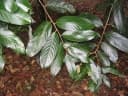
Shorea maxima
Shorea maxima
Safety & Hazards
None known
Cultivation Details
A plant of mainly lowland areas in the moist tropics, where it is found at elevations up to 1,300 metres[1].
Propagation
We have no specific information for this species - the information below is a general guide for the genus. Seed - best sown as soon as possible. It does not require pre-treatment, but it is recommended to soak the seed for 12 hours prior to sowing[2]. The seeds are sown in seedbeds, where they are covered with a mixture of sand and soil (1:1) or with a thin layer of sawdust[2]. Germination of fresh seeds is usually good and rapid. About two weeks after germination, when the seedlings are 5 - 6cm tall, they are potted up into individual containers about 15 x 23cm with good drainage holes at their base[2]. It is normally recommended to use a mixture of forest soil and sand (at a ratio of 3:1) as the potting medium in order to introduce the appropriate mycorrhiza to the roots. The seedlings are placed in 50 - 60% sunlight and watered twice daily[2]. Seedlings can be planted out when 30 - 40cm tall - harden the seedlings off in full sunlight for one month prior to planting[2]. Cite as: Tropical Plants Database, Ken Fern. tropical.theferns.info. 2026-02-20. <tropical.theferns.info/viewtropical.php?id=Shorea+maxima>
Pollinators
Data unavailable
References
- [1]Flora Malesiana Series 1 — Various · Nationaal Herbarium Nederiand, Universiteit Leiden branch · http://www.archive.org ↩︎A massive treatment of the plants of the Malaysian Archipelago. Much of it has been made available to download from the Internet
- [2]Seed Leaflets — Various · Forest & Landscape. Denmark · http://en.sl.life.ku.dk/Publikationer/Udgivelser/PopulaerPublikationer.aspx?katid={D28373CC-6EF3-4EF8-B097-6D83FABF209E}&serieid={9F1C3DB1-6E7B-4CF1-AF53-F480B0CB40EF}&sort=title ↩︎A series of leaflets, jointly produced by the University of Copenhagen and the Royal Botanic Gardens at Kew, focussing on seed information for a number species, but also giving a lot of other information about each plant.
- [3]Timber Notes - Light Hardwoods 1 — Choo K.T.; Gan K.S.; Lim S.C. · Timber Technology Centre; Kuala Lumpur · 1998 · https://info.frim.gov.my/infocenter/booksonline/ttb/TTBno9.pdf · ISBN 139-258 ↩︎An excellent series of leaflets, this one gives information on the wood of several species in the genus Shorea. It can be downloaded as a PDF document from the Internet.
- [4]IUCN Red List of Threatened Species — http://www.iucnredlist.org/ ↩︎A list of plants under threat and facing possible extinction, usually with brief details of the threats and information on habitat.
- [5]Flora of Peninsula Malaysia — http://www.tfbc.frim.gov.my ↩︎In the process of being assembled (15/07/09), it is currently a series of check sheets giving species name, brief description, habitat and high quality photos of the plants.
- [6]Dictionary of Economic Plants. — Uphof. J. C. Th. · Weinheim · 1959 · ISBN - ↩︎An excellent and very comprehensive guide but it only gives very short descriptions of the uses without any details of how to utilize the plants. Not for the casual reader.
- [7]Gums, Resins and Latexes of Plant Origins. — Coppen J.J.W. · FAO, United Nations; Rome · 1995 · http://www.fao.org/docrep/ · ISBN 92-5-103757-4 ↩︎A handbook published by the Food and Agriculture Organisation of the United Nations, it provides good basic information on the sources and uses of the various gums, resins and latexes. It can be downloaded from the Internet.