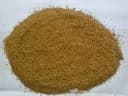
Setaria italica
Setaria italica
Safety & Hazards
None known
Cultivation Details
Setaria italica is a plant of the tmperate and subtropical zones, amenable to cultivation in the tropics where it is found at elevations up to 2,000 metres. It grows best in areas where annual daytime temperatures are within the range 16 - 26°c, but can tolerate 5 - 35°c[1]. It is intolerant of frost[2]. It prefers a mean annual rainfall in the range 500 - 700mm, but tolerates 300 - 4,000mm[1]. Grows best in a sunny position[3, 4]. Succeeds in any well-drained soil from light sands to heavy clays, preferring fertile conditions[3, 4]. Established plants have a deep root system and are very drought resistant[5, 6, 2]. Prefers a pH in the range 6 - 6.8, tolerating 5.5 - 8.3[1]. Plants can mature a crop in 60 - 120 days from sowing the seed, depending on conditions and variety[1]. Seed yields of 800 - 900 kilos per hectare can be attained from rain-fed crops; this has been increased to 1,800 kilo in China with selected forms and a rainfall of less 900mms[4, 2]. Experimental yields of 11 tonnes per hectare have been obtained with irrigation[4]. There are many named varieties[7, 8].
Propagation
Seed - sow early spring in a greenhouse and only just cover the seed. Germination is usually quick and good. Prick out the seedlings into individual pots as soon as they are large enough to handle and grow them on fast. Plant them out in late spring, after the last expected frosts. Whilst this is fine for small quantities, it would be an extremely labour intensive method if larger amounts were to be grown. The seed can be sown in situ in the middle of spring though it is then later in coming into flower and may not ripen its seed in a cool summer. Cite as: Temperate Plants Database, Ken Fern. temperate.theferns.info. 2026-02-21. <temperate.theferns.info/plant/Setaria+italica>
Pollinators
Wind
References
- [1]Ecocrop — http://ecocrop.fao.org/ecocrop/srv/en/home ↩︎Basic information on a wide range of useful plants, plus details of environmental needs where available.
- [2]Grassland Species - Profiles — http://www.fao.org/ag/AGP/AGPC/doc/Gbase/Default.htm ↩︎Terse information on over 650 species of plants that grow in grassland, including trees, shrubs and perennial plants as well as grasses. Gives a brief description of the plant, its range and habitat and some of its uses.
- [3]Ornamental Grasses. — Grounds. R. · Christopher Helm · 1989 · ISBN 0-7470-1219-9 ↩︎Cultivation details of many of the grasses and bamboos. Well illustrated.
- [4]Protabase - Plant Resources of Tropical Africa. — http://www.prota.org ↩︎An excellent on-line database with detailed information on over 3,200 species of useful plants of Africa.
- [5]Plants for Man. — Schery. R. W. ↩︎Fairly readable but not very comprehensive. Deals with plants from around the world.
- [6]A Dictionary of Plants Used by Man. — Usher. G. · Constable · 1974 · ISBN 0094579202 ↩︎Forget the sexist title, this is one of the best books on the subject. Lists a very extensive range of useful plants from around the world with very brief details of the uses. Not for the casual reader.
- [7]Dictionary of Economic Plants. — Uphof. J. C. Th. · Weinheim · 1959 · ISBN - ↩︎An excellent and very comprehensive guide but it only gives very short descriptions of the uses without any details of how to utilize the plants. Not for the casual reader.
- [8]Cornucopia - A Source Book of Edible Plants. — Facciola. S. · Kampong Publications · 1990 · ISBN 0-9628087-0-9 ↩︎Excellent. Contains a very wide range of conventional and unconventional food plants (including tropical) and where they can be obtained (mainly N. American nurseries but also research institutes and a lot of other nurseries from around the world.
- [9]Sturtevant's Edible Plants of the World. — Hedrick. U. P. · Dover Publications · 1972 · ISBN 0-486-20459-6 ↩︎Lots of entries, quite a lot of information in most entries and references.
- [10]The Oxford Book of Food Plants. — Harrison. S. Wallis. M. Masefield. G. · Oxford University Press · 1975 · ISBN - ↩︎Good drawings of some of the more common food plants from around the world. Not much information though.
- [11]Tanaka's Cyclopedia of Edible Plants of the World. — Tanaka. T. & Nakao S. · Keigaku Publishing; Tokyo · 1976 · ISBN - ↩︎The most comprehensive list of edible plants I've come across. Only the briefest entry for each species, though, and some of the entries are more than a little dubious. Not for the casual reader.
- [12]Medicinal Plants of China — Duke. J. A. and Ayensu. E. S. · Reference Publications, Inc. · 1985 · ISBN 0-917256-20-4 ↩︎Details of over 1,200 medicinal plants of China and brief details of their uses. Often includes an analysis, or at least a list of constituents. Heavy going if you are not into the subject.
- [13]Handbook of Chinese Herbs and Formulas. — Yeung. Him-Che. · Institute of Chinese Medicine, Los Angeles · 1985 · ISBN - ↩︎An excellent Chinese herbal giving information on over 500 species. Rather technical and probably best suited to the more accomplished user of herbs.
- [14]Chinese Materia Medica. — Stuart. Rev. G. A. · Taipei. Southern Materials Centre · 1911 · ISBN - ↩︎A translation of an ancient Chinese herbal. Fascinating.
- [PFAF]Plants for a Future — pfaf.org ↩︎