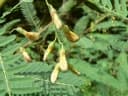
Sesbania sesban
Sesbania sesban
Safety & Hazards
Fresh seeds are poisonous to humans but are eaten after soaking for 3 days and then cooking[1].
Cultivation Details
A plant of the subtropics, also succeeding at higher elevations in the tropics, being found at elevations of 100 - 2,300 metres[2]. It grows best in areas where annual daytime temperatures are within the range 18 - 28°c, but can tolerate 10 - 45°c[1]. When dormant, the plant can survive temperatures down to about -5°c, but young growth can be severely damaged at -1°c[1]. It prefers a mean annual rainfall in the range 800 - 2,000mm, but tolerates m350 - 2,500m[1]. Requires a sunny position[1]. Tolerates saline, acidic and alkaline soils[2]. The plant has an outstanding ability to withstand waterlogging and is ideally suited to seasonally flooded environments. When flooded, it initiates floating, adventitious roots and protects its stems, roots and nodules with spongy, aerenchyma tissue[2]. It also shows some tolerance to moisture stress and tolerates soil alkalinity and salinity to a considerable degree[2]. Prefers a pH in the range 5 - 7, tolerating 4 - 9.9[1]. A fast-growing, but short-lived plant, often dying before it is 10 years old[2, 1]. It has been reported to attain a height of 4 - 5 metres in only 6 months[2]. It thrives under repeated cuttings and coppices readily, with many branches arising from the main stem below cutting height[2]. Cutting frequencies are generally 3 - 4 cuts/annum, but up to 8 cuts are made in some areas[2]. Yields have ranged from 4 to 12 tonnes/hectare dry matter per year, depending on location[2]. Cutting height can also influence yield, with cutting heights of 50 - 76 cm favouring plant survival and productivity[2]. This species has a symbiotic relationship with certain soil bacteria, these bacteria form nodules on the roots and fix atmospheric nitrogen. Some of this nitrogen is utilized by the growing plant but some can also be used by other plants growing nearby[3]. The rhizobium requirements vary. There is a host-strain interaction, and different accessions of the plant require different strains of bacteria[2].
Propagation
Seed - requires pre-treatment to soften the hard seedcoat and allow the ingress of water[2]. This can be done by soaking the seed in a small amount of nearly boiling water (which cools down quickly and does not cook the seed) and then soaking the seed for 12 - 24 hours in warm water. Alternatively, a small area of the seed coat can be abraded, being careful not to damage the embryo[PFAF]. The germination rate of treated seed is about 65% in about 16 days[2]. Seed storage behaviour is orthodox. Viability can be maintained for 2 years in open storage at room temperature[2]. Cite as: Tropical Plants Database, Ken Fern. tropical.theferns.info. 2026-02-20. <tropical.theferns.info/viewtropical.php?id=Sesbania+sesban>
Pollinators
Bees
References
- [1]Ecocrop — http://ecocrop.fao.org/ecocrop/srv/en/home ↩︎Basic information on a wide range of useful plants, plus details of environmental needs where available.
- [2]World Agroforesty Centre — http://www.worldagroforestry.org/ ↩︎An excellent online database of a huge range of trees giving very good information on each plant - its uses, ecology, identity, propagation, pests etc.
- [3]The New RHS Dictionary of Gardening. 1992. — Huxley. A. · MacMillan Press · 1992 · ISBN 0-333-47494-5 ↩︎Excellent and very comprehensive, though it contains a number of silly mistakes. Readable yet also very detailed.
- [4]Mansfeld's Database of Agricultural and Horticultural Plants — http://mansfeld.ipk-gatersleben.de/pls/htmldb_pgrc/f?p=185:3:4292127278597336 ↩︎Terse details of a huge range of useful plants.
- [5]Cornucopia II — Facciola. S. · Kampong Publications, California. · 1998 · ISBN 0-9628087-2-5 ↩︎The second edition of an excellent guide to the edible uses of plants, though it does not give any details of cultivation etc.
- [6]Dictionary of Economic Plants. — Uphof. J. C. Th. · Weinheim · 1959 · ISBN - ↩︎An excellent and very comprehensive guide but it only gives very short descriptions of the uses without any details of how to utilize the plants. Not for the casual reader.
- [PFAF]Plants for a Future — pfaf.org ↩︎