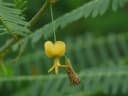
Sesbania bispinosa
Sesbania bispinosa
Safety & Hazards
None known
Cultivation Details
A plant of subtropical to tropical areas, where it is found at elevations up to 1,200 metres[1]. It grows best in areas where the mean annual temperature falls within the range 18 - 30°c, though it can tolerate 10 - 34°c[1]. It prefers a mean annual rainfall of 700 - 1,200mm, but tolerates 500 - 2,900mm[1]. Prefers a sunny position[1]. Succeeds in heavy soils[2]. Grows well under both water-logged or non-irrigated conditions[2]. The plant is very tolerant of soil types, tolerating a pH ranging from 4.3 right up to 10[2, 1]. The plant can become a weed in rice paddy fields[2]. A very fast growing plant, it competes well with weeds and may even suppress growth of Imperata cylindrica on sites where moisture is adequate[2]. A green manure crop can be produced in 2 - 3 months from seed, and a fuel wood or seed crop in 5 - 6 months[2]. Seed yields may be 600 - 1000 kg/ha, f[1]. If used as a green manure crop for rice, the plant should be ploughed in just before the rice is planted out[2]. Delaying the rice planting may lower its response to the green manure[2]. The leaves of sesbania follow the direction of sunlight and fold at night[2]. This species has a symbiotic relationship with certain soil bacteria, these bacteria form nodules on the roots and fix atmospheric nitrogen. Some of this nitrogen is utilized by the growing plant but some can also be used by other plants growing nearby[3].
Propagation
Seed - no pre-treatment is required. The plants can easily be established by direct seeding[2]. The seed has a hard seedcoat and may benefit from scarification before sowing to speed up germination. This can usually be done by pouring a small amount of nearly boiling water on the seeds (being careful not to cook them!) and then soaking them for 12 - 24 hours in warm water. By this time they should have imbibed moisture and swollen - if they have not, then carefully make a nick in the seedcoat (being careful not to damage the embryo) and soak for a further 12 hours before sowing[PFAF]. Seed storage behaviour is orthodox; a germination rate of 24% has been recorded following 41 years of open storage at room temperature[2]. Cite as: Tropical Plants Database, Ken Fern. tropical.theferns.info. 2026-02-20. <tropical.theferns.info/viewtropical.php?id=Sesbania+bispinosa>
Pollinators
Bees, Self
References
- [1]Ecocrop — http://ecocrop.fao.org/ecocrop/srv/en/home ↩︎Basic information on a wide range of useful plants, plus details of environmental needs where available.
- [2]World Agroforesty Centre — http://www.worldagroforestry.org/ ↩︎An excellent online database of a huge range of trees giving very good information on each plant - its uses, ecology, identity, propagation, pests etc.
- [3]Nodulation Plants in GRIN Taxonomy — United States Department of Agriculture · http://www.ars-grin.gov/~sbmljw/cgi-bin/taxnodul.pl?language=en ↩︎An online database listing plants that have either positive or negative reports on root and stem nodulation with nitrogen-fixing bacteria.
- [4]African Flowering Plants Database — Conservatoire et Jardin Botaniques. · http://www.ville-ge.ch/musinfo/bd/cjb/africa/recherche.php ↩︎Contains information on over 150,000 plant names (including synonyms) giving a description and habitat, plus a distribution map.
- [5]Flora of China — Missouri Botanical Garden Press; St. Louis. · 1994 · http://flora.huh.harvard.edu/china/ ↩︎An excellent, comprehensive resource in 25 volumes. In addition to the botanical information the flora also gives basic information on habitat and some uses. An on-line version is also available.
- [6]Mansfeld's Database of Agricultural and Horticultural Plants — http://mansfeld.ipk-gatersleben.de/pls/htmldb_pgrc/f?p=185:3:4292127278597336 ↩︎Terse details of a huge range of useful plants.
- [7]IUCN Red List of Threatened Species — http://www.iucnredlist.org/ ↩︎A list of plants under threat and facing possible extinction, usually with brief details of the threats and information on habitat.
- [8]Dictionary of Economic Plants. — Uphof. J. C. Th. · Weinheim · 1959 · ISBN - ↩︎An excellent and very comprehensive guide but it only gives very short descriptions of the uses without any details of how to utilize the plants. Not for the casual reader.
- [PFAF]Plants for a Future — pfaf.org ↩︎