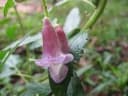
Sesamum radiatum
Sesamum radiatum
Safety & Hazards
None known
Cultivation Details
Requires a sunny position[1]. Succeeds on nutritionally poor sites, growing in gravelly, sandy and rocky localities[1]. Established plants are drought tolerant and continue to grow and flower during the dry season[1]. The plant is a pan-tropical weed[2]. The first leaves can be harvested 8 - 10 weeks after sowing. Harvesting at 7 - 10-day intervals can continue for a period of about 14 weeks[1]. In Nigeria a leaf yield of 5 - 6 tonnes per hectare can be expected[1]. It takes about 4 months from germination until the seeds are ready to harvest[1]. The plant shows indeterminate growth, so that flowering continues as long as environmental conditions permit[1]. This is longer than is usual for sesame (Sesamum indicum)[1]. It takes about 6 weeks from anthesis to fruit maturity. The fruits do not open fully; an angular pocket at the base of the fruit retains some seeds[1]. For leaf production, the plants are topped to promote the growth of new basal shoots from which larger leaves can be harvested[1]. Plants in their second year may be pruned to a height of 2 - 5cm to encourage new shoot production[1]. The plant is primarily self-pollinated; the flowers opening at dawn after pollination has occurred[1]. However, under extreme conditions some outcrossing may occur[1].
Propagation
Seed - it can be sown into seedbeds, in seed boxes or directly into the place where it is to grow, placing 2 - 3 seeds per hole. Germination takes 6 - 10 days. Seedlings are transplanted at a spacing of approximately 15cm[1]. Cite as: Tropical Plants Database, Ken Fern. tropical.theferns.info. 2026-02-20. <tropical.theferns.info/viewtropical.php?id=Sesamum+radiatum>
Pollinators
Self
References
- [1]Protabase - Plant Resources of Tropical Africa. — http://www.prota.org ↩︎An excellent on-line database with detailed information on over 3,200 species of useful plants of Africa.
- [2]The Useful Plants of West Tropical Africa. — Burkil. H. M. · Royal Botanic Gardens; Kew. · 1985 - 2004 ↩︎Brief descriptions and details of the uses of over 4,000 plants. A superb, if terse, resource, it is also available electronically on the Web - see http://www.aluka.org/
- [3]Mansfeld's Database of Agricultural and Horticultural Plants — http://mansfeld.ipk-gatersleben.de/pls/htmldb_pgrc/f?p=185:3:4292127278597336 ↩︎Terse details of a huge range of useful plants.
- [4]Cornucopia II — Facciola. S. · Kampong Publications, California. · 1998 · ISBN 0-9628087-2-5 ↩︎The second edition of an excellent guide to the edible uses of plants, though it does not give any details of cultivation etc.