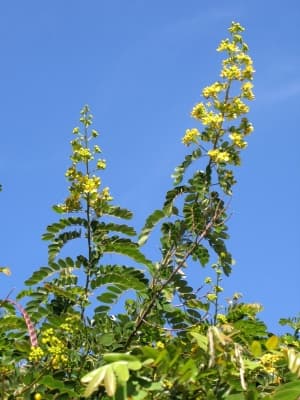
Senna singueana
Senna singueana
Safety & Hazards
The species is known to be toxic[1].
Cultivation Details
A plant of low to moderate elevations in the drier tropics, where it can be found from sea level to over 2,000 metres. It is found mainly in areas where the mean annual temperature is from 25 - 30°c, and the mean annual rainfall is within the range 500 - 1,000mm[2, 3]. A fast-growing plant[2]. The plant responds well to coppicing[2, 3]. The plant is fairly susceptible to fire, though its thick bark does give it some protection[2]. Although many species within the family Fabaceae have a symbiotic relationship with soil bacteria, this species is said to be devoid of such a relationship and therefore does not fix atmospheric nitrogen[4].
Propagation
Seed - pre-soak in warm water for 12 hours prior to sowing. The seed usually sprouts within 9 days of sowing, with around 78% germinating[2]. Cite as: Tropical Plants Database, Ken Fern. tropical.theferns.info. 2026-02-20. <tropical.theferns.info/viewtropical.php?id=Senna+singueana>
Pollinators
Bees
References
- [1]Edible Wild Plants of Tanzania — Ruffo, C.K.: Birnie, A. & Tengnas, B. · Regional Land Management Unit; Nairobi. · 2002 · ISBN 9966-896-60-0 ↩︎A very well presented, simple guide to growing and utilizing wild food plants in Tanzania, with line drawings of each plant, a description, habitat and range, non-food as well as food uses, plus basic information on growing the plants.
- [2]Protabase - Plant Resources of Tropical Africa. — http://www.prota.org ↩︎An excellent on-line database with detailed information on over 3,200 species of useful plants of Africa.
- [3]World Agroforesty Centre — http://www.worldagroforestry.org/ ↩︎An excellent online database of a huge range of trees giving very good information on each plant - its uses, ecology, identity, propagation, pests etc.
- [4]Nodulation Plants in GRIN Taxonomy — United States Department of Agriculture · http://www.ars-grin.gov/~sbmljw/cgi-bin/taxnodul.pl?language=en ↩︎An online database listing plants that have either positive or negative reports on root and stem nodulation with nitrogen-fixing bacteria.
- [5]Flora of Southern Africa — Roux J.P. · 2003 · http://plants.jstor.org/search?st=662545 ↩︎An excellent on-line resource.
- [6]Field Guide to the Moist Forest Trees of Tanzania. — Lovett J.C.; Ruffo C.K.; Gereau R.E.; Taplin J.R.D · Frontier · http://www.york.ac.uk/res/celp/webpages/projects/ecology/tree%20guide/introduction.htm · ISBN 1-873070-33-0 ↩︎A lovely little book giving a basic identification guide to more than 650 species of trees growing in Tanzania. It is also available to view on the internet.