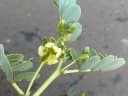
Senna italica
Senna italica
Safety & Hazards
None known
Cultivation Details
Plants succeed in drier areas of the tropics and subtropics. Prefers a deep, well-drained, moderately fertile sandy loam and a position in full sun[1]. Flowering usually takes place during the rainy season[2]. The economic life of the crop is 3 years at the most[2]. The crop can be rejuvenated by natural regeneration[2]. Senna italica is a host of the root lesion nematode (Pratylenchus penetrans)[2]. In experiments, the growth of Senna italica was enhanced by inoculation with a mixture of vesicular arbuscular mycorrhizal (VAM) inoculum[2]. Although many species within the family Fabaceae have a symbiotic relationship with soil bacteria, this species is said to be devoid of such a relationship and therefore does not fix atmospheric nitrogen[3].
Propagation
Seed - pre-soaking for 12 hours in warm water, or abrading the seed with sand can improve germination rates and reduce germination time[2]. The seed germinates easily and is often sown in situ, placing 5 seeds per station and then thinning to the best three plants[2]. Cite as: Tropical Plants Database, Ken Fern. tropical.theferns.info. 2026-02-20. <tropical.theferns.info/viewtropical.php?id=Senna+italica>
Pollinators
Data unavailable
References
- [1]The New RHS Dictionary of Gardening. 1992. — Huxley. A. · MacMillan Press · 1992 · ISBN 0-333-47494-5 ↩︎Excellent and very comprehensive, though it contains a number of silly mistakes. Readable yet also very detailed.
- [2]Protabase - Plant Resources of Tropical Africa. — http://www.prota.org ↩︎An excellent on-line database with detailed information on over 3,200 species of useful plants of Africa.
- [3]Nodulation Plants in GRIN Taxonomy — United States Department of Agriculture · http://www.ars-grin.gov/~sbmljw/cgi-bin/taxnodul.pl?language=en ↩︎An online database listing plants that have either positive or negative reports on root and stem nodulation with nitrogen-fixing bacteria.