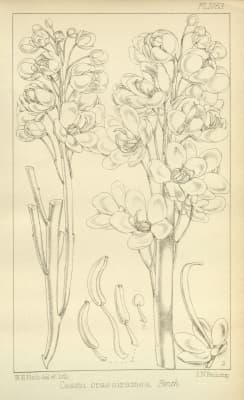
Senna crassiramea
Senna crassiramea
Safety & Hazards
None known
Cultivation Details
A plant of higher elevations in the drier tropics and subtropics, being found usually at elevations above 2,000 metres. It is found in areas where the mean annual temperature is around 18.5°c and the mean annual rainfall is around 290mm[1]. Although many species within the family Fabaceae have a symbiotic relationship with soil bacteria, this species is said to be devoid of such a relationship and therefore does not fix atmospheric nitrogen[2].
Propagation
Seed - it has a hard seedcoat and may benefit from scarification before sowing in order to speed up and improve germination. This can usually be done by pouring a small amount of nearly boiling water on the seeds (being careful not to cook them!) and then soaking them for 12 - 24 hours in warm water. By this time they should have imbibed moisture and swollen - if they have not, then carefully make a nick in the seedcoat (being careful not to damage the embryo) and soak for a further 12 hours before sowing. Cite as: Tropical Plants Database, Ken Fern. tropical.theferns.info. 2026-02-20. <tropical.theferns.info/viewtropical.php?id=Senna+crassiramea>
Pollinators
Data unavailable
References
- [1]Novon Vol.4 — Missouri Botanical Garden; Missouri. · 1994 · http://www.biodiversitylibrary.org ↩︎A botanical magazine, focussing on publishing new and amended names of species. It can be downloaded from the Internet.
- [2]Nodulation Plants in GRIN Taxonomy — United States Department of Agriculture · http://www.ars-grin.gov/~sbmljw/cgi-bin/taxnodul.pl?language=en ↩︎An online database listing plants that have either positive or negative reports on root and stem nodulation with nitrogen-fixing bacteria.
- [3]Dictionary of Economic Plants. — Uphof. J. C. Th. · Weinheim · 1959 · ISBN - ↩︎An excellent and very comprehensive guide but it only gives very short descriptions of the uses without any details of how to utilize the plants. Not for the casual reader.