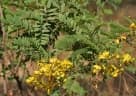
Cultivation Details
A plant mainly of dry regions in the tropics, though it is also able to tolerate much wetter conditions. It grows best in areas where the mean annual temperature is in the range 16 - 27°c and can tolerate a mean annual precipitation as low as 400mm, or up to 4,300 mm[1]. Requires a position in full sun[1]. Tolerant of many soil types, including saline, but prefers a fairly rich, well-drained soil[1]. Plants are fairly fast-growing and can reach a height of about 3 metres with 35mm stem diameter within 2 years; and a height of about 5 metres with 70mm stem diameter within 4 years[1]. Plants respond well to coppicing[1]. Plants can be harvested for tannins and dyestuff from the third year onwards, with the plants being coppiced annually[1]. Flowering and fruiting is often almost throughout the year, though there can be periods of increased flowering at times of the monsoon[1]. Although many species within the family Fabaceae have a symbiotic relationship with soil bacteria, this species is said to be devoid of such a relationship and therefore does not fix atmospheric nitrogen[3].
Propagation
Seed - it has a hard seedcoat and needs scarification before sowing to speed up germination. This can usually be done by pouring a small amount of nearly boiling water on the seeds (being careful not to cook them!) and then soaking them for 12 - 24 hours in warm water. By this time they should have imbibed moisture and swollen - if they have not, then carefully make a nick in the seedcoat (being careful not to damage the embryo) and soak for a further 12 hours. Cuttings. Cite as: Tropical Plants Database, Ken Fern. tropical.theferns.info. 2026-02-20. <tropical.theferns.info/viewtropical.php?id=Senna+auriculata>
Pollinators
Data unavailable
References
- [1]Protabase - Plant Resources of Tropical Africa. — http://www.prota.org ↩︎An excellent on-line database with detailed information on over 3,200 species of useful plants of Africa.
- [2]Plant Resources of Southeast Asia — http://proseanet.org/ ↩︎Lots of information on the uses of the plants of SE Asia.
- [3]Nodulation Plants in GRIN Taxonomy — United States Department of Agriculture · http://www.ars-grin.gov/~sbmljw/cgi-bin/taxnodul.pl?language=en ↩︎An online database listing plants that have either positive or negative reports on root and stem nodulation with nitrogen-fixing bacteria.
- [4]Mansfeld's Database of Agricultural and Horticultural Plants — http://mansfeld.ipk-gatersleben.de/pls/htmldb_pgrc/f?p=185:3:4292127278597336 ↩︎Terse details of a huge range of useful plants.
- [5]Cornucopia II — Facciola. S. · Kampong Publications, California. · 1998 · ISBN 0-9628087-2-5 ↩︎The second edition of an excellent guide to the edible uses of plants, though it does not give any details of cultivation etc.
- [6]Useful Fiber Plants of the World — Dodge C.R. · USDA; Washington. · 1897 · http://www.biodiversitylibrary.org/ ↩︎A rather dated, but very comprehensive catalogue of fibre plants from around the world. The book can be downloaded from the Internet.
- [PFAF]Plants for a Future — pfaf.org ↩︎