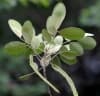
Senna atomaria
Senna atomaria
Safety & Hazards
None known
Cultivation Details
A plant of the tropics where it can be found at elevations up to 2,000 metres. It grows best in areas where the mean annual rainfall is within the range 500 - 1,200mm[1]. Succeeds in full sun and in dappled, woodland shade[2]. Often found wild on rocky and escessively drained soils with a wide range of textures[2]. The plant has tolerated saline soils in trials[1]. Tolerant of mildly acid to mildly alkaline soils[2]. The leaves, twigs, and other vegetative parts have an unpleasant odour[2]. Trees have a moderate rate of growth[2]. The plant regrows vigorously after being coppiced or pollarded, producing much biomass. It can be used for fuel production[1].
Propagation
Like many species within the family Fabaceae, once they have been dried for storage the seeds of this species may benefit from scarification before sowing in order to speed up and improve germination. This can usually be done by pouring a small amount of nearly boiling water on the seeds (being careful not to cook them!) and then soaking them for 12 - 24 hours in warm water. By this time they should have imbibed moisture and swollen - if they have not, then carefully make a nick in the seedcoat (being careful not to damage the embryo) and soak for a further 12 hours before sowing[PFAF]. Sow the seed in a nursery seedbed. Germination takes place in 3 - 15 days, with a very high percentage of seeds sprouting[2]. Plant out into permanent positions when around 20cm tall, which should be about 3 months or more after germination[1]. Cite as: Tropical Plants Database, Ken Fern. tropical.theferns.info. 2026-02-20. <tropical.theferns.info/viewtropical.php?id=Senna+atomaria>
Pollinators
Data unavailable
References
- [1]World Agroforesty Centre — http://www.worldagroforestry.org/ ↩︎An excellent online database of a huge range of trees giving very good information on each plant - its uses, ecology, identity, propagation, pests etc.
- [2]Wildland Shrubs of the United States and its Territories: Thamnic Descriptions — Francis J.K. (Editor) · USDA; Forest Service International Institute of Tropical Forestr · 2000 · http://www.fs.fed.us/global/iitf/wildland_shrubs.htm ↩︎An excellent series of papers, in PDF format, from various authors giving quite detailed information on a range of shrubs growing in the United States and its Territories. It can be downloaded from the Internet.
- [3]Protabase - Plant Resources of Tropical Africa. — http://www.prota.org ↩︎An excellent on-line database with detailed information on over 3,200 species of useful plants of Africa.
- [PFAF]Plants for a Future — pfaf.org ↩︎