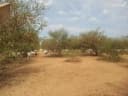
Senegalia senegal
Senegalia senegal
Safety & Hazards
Especially in times of drought, many Acacia species can concentrate high levels of the toxin Hydrogen cyanide in their foliage, making them dangerous for herbivores to eat.
Cultivation Details
A plant for the drier tropical areas, where it can be found at elevations from 100 - 1,700 metres[1]. Tolerates a minimum temperature of about 15°c[2]. Plants can tolerate high daily temperatures, but are sensitive to frost[1, 3]. Prefers areas where the mean annual rainfall is 300 - 400mm, but can survive with as little as 100mm and a dry period of 8 - 11 months[1]. Grows best in a moist, well-drained, neutral to acid soil[2, 3]. Gum production is best when the plant grows in a poor soil[3]. Prefers a pH in the range 5 - 8[4]. Established plants are very drought tolerant[1, 3]. Plants can be coppiced and pollarded[3]. Wood yields of 120 - 190 cubic metres per hectare, with annual increments of 0.5 - 1.0 cubic metres per hectare have been recorded[5]. The gum exudes from ducts in the inner bark; it is tapped in the hot season when the trees are stressed. Tapping begins when trees are 4 - 5 years old, commencing after leaf fall and ceasing during the colder months of the dry season. Gum nodules form in 3 - 8 weeks, exuding from the former broken abscission scars[5]. Care should be taken to keep the gum clean[5]. Annual yields stand at 188 - 2,856g for young trees and 379 - 6,754g for older trees (7-15 years). Gum production is excellent on poor soils and higher in stressed trees[5]. This species has a symbiotic relationship with certain soil bacteria, these bacteria form nodules on the roots and fix atmospheric nitrogen. Some of this nitrogen is utilized by the growing plant but some can also be used by other plants growing nearby[6].
Propagation
Seed - unlike other acacias, the seed coat is not impermeable to water even after storage, and scarification is normally not necessary[1]. Germination is improved, however, if the seed is pre-soaked for 24 hours in warm water prior to sowing[2, 1]. The seed can be sown in individual pots, preferably deep pots to allow the taproot to develop[1]. It usually germinates quickly and freely, sprouting best at a temperature around 21°c[2]. Plants make a deep taproot and resent root disturbance, they should be planted out into their permanent positions as soon as possible[2]. Semi-ripe cuttings of lateral shoots[2]. Cite as: Tropical Plants Database, Ken Fern. tropical.theferns.info. 2026-02-20. <tropical.theferns.info/viewtropical.php?id=Senegalia+senegal>
Pollinators
Bees, Insects
References
- [1]Seed Leaflets — Various · Forest & Landscape. Denmark · http://en.sl.life.ku.dk/Publikationer/Udgivelser/PopulaerPublikationer.aspx?katid={D28373CC-6EF3-4EF8-B097-6D83FABF209E}&serieid={9F1C3DB1-6E7B-4CF1-AF53-F480B0CB40EF}&sort=title ↩︎A series of leaflets, jointly produced by the University of Copenhagen and the Royal Botanic Gardens at Kew, focussing on seed information for a number species, but also giving a lot of other information about each plant.
- [2]Encyclopaedia of Herbs and their Uses. — Bown. D. · Dorling Kindersley, London. · 1995 · ISBN 0-7513-020-31 ↩︎A very well presented and informative book on herbs from around the globe. Plenty in it for both the casual reader and the serious student. Just one main quibble is the silly way of having two separate entries for each plant.
- [3]Useful Trees and Shrubs in Eritrea — Bein. E.; Habte. B.; Jaber. A.; Birnie. A. & Tengnas. B. · Regional Soil Conservation Unit: Nairobi · 1996 · ISBN 9966-896-24-4 ↩︎A very well written and concise guide to almost 200 species. It gives a brief description of each plant together with its habitat, uses, propagation and cultivation. Line drawings of each plant are also included It can be downloaded from the internet
- [4]Trees and Shrubs of the Sahel. Their Characteristics and Uses. — von Maydell H. · Deutsche Gesellschaft fur Technische Zusammenarbeit; Germany · 1990 · ISBN 3-8236-1198-4 ↩︎A well-researched book, usually with more than one photograph of each species and good information on the plant and its uses.
- [5]World Agroforesty Centre — http://www.worldagroforestry.org/ ↩︎An excellent online database of a huge range of trees giving very good information on each plant - its uses, ecology, identity, propagation, pests etc.
- [6]The New RHS Dictionary of Gardening. 1992. — Huxley. A. · MacMillan Press · 1992 · ISBN 0-333-47494-5 ↩︎Excellent and very comprehensive, though it contains a number of silly mistakes. Readable yet also very detailed.
- [7]Protabase - Plant Resources of Tropical Africa. — http://www.prota.org ↩︎An excellent on-line database with detailed information on over 3,200 species of useful plants of Africa.
- [8]Dictionary of Economic Plants. — Uphof. J. C. Th. · Weinheim · 1959 · ISBN - ↩︎An excellent and very comprehensive guide but it only gives very short descriptions of the uses without any details of how to utilize the plants. Not for the casual reader.
- [9]Antimicrobial Activity of Tanzanian Chewing Sticks Against Oral Pathogenic Microbes — Maryam N. Khan, Olipa Ngassapa & Mecky I.N. Matee · 2000 · https://doi.org/10.1076/1388-0209(200007)3831-SFT235 ↩︎