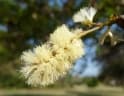
Senegalia nigrescens
Senegalia nigrescens
Safety & Hazards
Especially in times of drought, many Acacia species can concentrate high levels of the toxin Hydrogen cyanide in their foliage, making them dangerous for herbivores to eat.
Cultivation Details
Growth is slow, with a maximum annual increment of 60cm in height, usually much less[1]. The tree is completely deciduous and bare for several months, frequently flowering when leafless. The flowers are an important food resource to giraffe in the late dry season, and it has been suggested that giraffe could be a pollen vector[1]. The tree usually survives bush fires, resprouting from the base when top-killed[1, 2]. This species has a symbiotic relationship with certain soil bacteria, these bacteria form nodules on the roots and fix atmospheric nitrogen. Some of this nitrogen is utilized by the growing plant but some can also be used by other plants growing nearby[1].
Propagation
Seed - easy to produce in the nursery the seeds are usually sown into seedbeds, but sowing directly into pots is also possible because of the high germination rate. Seedlings suitable for transplanting have been produced in less than 9 months[1]. The seed of many members of this genus has a hard seedcoat and may benefit from scarification before sowing to speed up germination. This can usually be done by pouring a small amount of nearly boiling water on the seeds (being careful not to cook them!) and then soaking them for 12 - 24 hours in warm water. By this time they should have imbibed moisture and swollen - if they have not, then carefully make a nick in the seedcoat (being careful not to damage the embryo) and soak for a further 12 hours before sowing. Cite as: Tropical Plants Database, Ken Fern. tropical.theferns.info. 2026-02-20. <tropical.theferns.info/viewtropical.php?id=Senegalia+nigrescens>
Pollinators
Bees
References
- [1]Protabase - Plant Resources of Tropical Africa. — http://www.prota.org ↩︎An excellent on-line database with detailed information on over 3,200 species of useful plants of Africa.
- [2]Trees and Shrubs of the Okavango Delta; Medicinal Uses and Nutritional Value — Roodt V. · Shell Oil Botswana (Pty) Ltd; Gaborone, Botswana · 1998 · ISBN 99912-0-241-2 ↩︎A concise guide to some of the trees and shrubs of Botswana, often giving some of the plant's uses.
- [3]The Useful Native Plants of Australia. — Maiden J.H. · Turner & Co.; London. · 1889 · http://www.biodiversitylibrary.org ↩︎Terse details of the uses of many Australian plants and other species naturalised, or at least growing, in Australia. It can be downloaded from the Internet.
- [PFAF]Plants for a Future — pfaf.org ↩︎