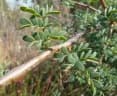
Senegalia mellifera
Senegalia mellifera
Safety & Hazards
Especially in times of drought, many Acacia species can concentrate high levels of the toxin Hydrogen cyanide in their foliage, making them dangerous for herbivores to eat.
Cultivation Details
A plant of the semi-arid grasslands of tropical and subtropical Africa, it is found at elevations from sea level to 1,500 metres[1]. It grows in areas where the mean annual rainfall is in the range 250 - 700mm[1]. Prefers loamy soils, though it grows well in black cotton soils and can succeed in a variety of soils from sandy to heavy clays[1, 2]. It grows on brackish soils in Botswana[3]. Established plants are drought-tolerant[1]. The plant has a shallow but extensive root system radiating from the crown, allowing the plant to exploit soil moisture and nutrients from a large volume of soil[1]. The roots rarely penetrate more than 1 metre into the soil[1]. Trees have a moderate growth rate of up to 500mm per year[1]. Trees do not coppice well[1], but often sucker very freely[2]. Flowering and fruiting start 3 years after planting and generally occur twice a year. Flowers are borne on shoots produced the previous year, that is, old wood. The flowers open and shed before the leaves appear[1]. The cream/white flowers produce excellent quality honey[1]. Due to its high rate of seeding, long viability of seed and ability to overcome arid climates, profuse natural regeneration is generally common[1]. If left unattended, especially if grazing is heavy and no fires check its spread, this species may form dense, impenetrable thickets, 2 - 3 metres high and sometimes hundreds of metres across, slowly taking over grazing land[1]. This species has a symbiotic relationship with certain soil bacteria, these bacteria form nodules on the roots and fix atmospheric nitrogen. Some of this nitrogen is utilized by the growing plant but some can also be used by other plants growing nearby[4].
Propagation
Seed - pre-soak overnight in hot water that is allowed to cool[1]. Commercially the seeds are scarified by soaking them in concentrated sulphuric acid for 5-15 min prior to sowing[1]. Direct sowing of seeds is the common method of artificial propagation - the seeds usually germinating from the 5th day onwards[1]. Seed storage behaviour is orthodox; viability can be maintained for several years in hermetic storage at 10°c with 4.5-9% mc[1]. Cite as: Tropical Plants Database, Ken Fern. tropical.theferns.info. 2026-02-20. <tropical.theferns.info/viewtropical.php?id=Senegalia+mellifera>
Pollinators
Bees, Lepidoptera
References
- [1]World Agroforesty Centre — http://www.worldagroforestry.org/ ↩︎An excellent online database of a huge range of trees giving very good information on each plant - its uses, ecology, identity, propagation, pests etc.
- [2]Seed Leaflets — Various · Forest & Landscape. Denmark · http://en.sl.life.ku.dk/Publikationer/Udgivelser/PopulaerPublikationer.aspx?katid={D28373CC-6EF3-4EF8-B097-6D83FABF209E}&serieid={9F1C3DB1-6E7B-4CF1-AF53-F480B0CB40EF}&sort=title ↩︎A series of leaflets, jointly produced by the University of Copenhagen and the Royal Botanic Gardens at Kew, focussing on seed information for a number species, but also giving a lot of other information about each plant.
- [3]Trees and Shrubs of the Okavango Delta; Medicinal Uses and Nutritional Value — Roodt V. · Shell Oil Botswana (Pty) Ltd; Gaborone, Botswana · 1998 · ISBN 99912-0-241-2 ↩︎A concise guide to some of the trees and shrubs of Botswana, often giving some of the plant's uses.
- [4]The New RHS Dictionary of Gardening. 1992. — Huxley. A. · MacMillan Press · 1992 · ISBN 0-333-47494-5 ↩︎Excellent and very comprehensive, though it contains a number of silly mistakes. Readable yet also very detailed.
- [5]Trees and Shrubs of the Sahel. Their Characteristics and Uses. — von Maydell H. · Deutsche Gesellschaft fur Technische Zusammenarbeit; Germany · 1990 · ISBN 3-8236-1198-4 ↩︎A well-researched book, usually with more than one photograph of each species and good information on the plant and its uses.
- [6]Dictionary of Economic Plants. — Uphof. J. C. Th. · Weinheim · 1959 · ISBN - ↩︎An excellent and very comprehensive guide but it only gives very short descriptions of the uses without any details of how to utilize the plants. Not for the casual reader.
- [7]Encyclopaedia of Herbs and their Uses. — Bown. D. · Dorling Kindersley, London. · 1995 · ISBN 0-7513-020-31 ↩︎A very well presented and informative book on herbs from around the globe. Plenty in it for both the casual reader and the serious student. Just one main quibble is the silly way of having two separate entries for each plant.
- [8]The Useful Native Plants of Australia. — Maiden J.H. · Turner & Co.; London. · 1889 · http://www.biodiversitylibrary.org ↩︎Terse details of the uses of many Australian plants and other species naturalised, or at least growing, in Australia. It can be downloaded from the Internet.
- [9]Gemsbok Bean and Kalahari Truffle — Leffers A. · Gamsberg MacMillan; Namibia. · 2003 · ISBN 99916-0-491-X ↩︎Details of the traditional uses of over 200 species of plants in northeastern Namibia. Written for the non-expert, there is usually at least one photograph with each plant entry.
- [PFAF]Plants for a Future — pfaf.org ↩︎