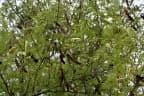
Senegalia catechu
Senegalia catechu
Safety & Hazards
The bark contains an alkaloid and is said to be toxic[1]. Both fruit and stem are used in Myanmar to poison fish[1]. Especially in times of drought, many Acacia species can concentrate high levels of the toxin Hydrogen cyanide in their foliage, making them dangerous for herbivores to eat.
Cultivation Details
A plant for sub-tropical to tropical areas, tolerating a minimum temperature of about 7°c[2]. It is especially common in the drier regions, but can also be grown in the more humid climates of South-East Asia at elevations from sea-level to about 1,500 metres. It succeeds in areas where annual daytime temperatures acan reach 32 - 39°c, and the mean annual rainfall is in the range 500 - 2,000mm[1, 3]. Requires a sunny position[4]. Grows best in a well-drained, neutral to acid soil[2]. Succeeds in a wide range of soils, including poor, shallow ones[1]. Intolerant of clay soils[3]. The tree starts flowering and producing pods when 5 - 7 years old[3]. Trees with a girth of 60 - 120cm are generally preferred for cutch production. The wood can be harvested when the trees are 30 years old in good sites, 50 years old in moderate sites, and 60 years old in poor sites. The whole tree is felled and transported to factories[3]. The wood of freshly felled trees yields more cutch than dried wood[3]. In 60-year-old plantations in India the yield of heartwood in good sites is 75 cubic metres per hectare, in moderate sites 63 cubic metres, and in poor sites 50 cubic metres. In these plantations the yield of cutch can be estimated at 6 tonnes per hectare, 5 tonnes and 4 tonnes respectively[3]. This species has a symbiotic relationship with certain soil bacteria, these bacteria form nodules on the roots and fix atmospheric nitrogen. Some of this nitrogen is utilized by the growing plant but some can also be used by other plants growing nearby[5].
Propagation
The seed of most, if not all, members of this genus has a hard seedcoat and may benefit from scarification before sowing to speed up germination. This can usually be done by pouring a small amount of nearly boiling water on the seeds (being careful not to cook them!) and then soaking them for 12 - 24 hours in warm water. By this time they should have imbibed moisture and swollen - if they have not, then carefully make a nick in the seedcoat (being careful not to damage the embryo) and soak for a further 12 hours before sowing. Seed germinates best at a temperature around 21°c[2]. Sprouting commences around 5 - 7 days after sowing the treated seed[3]. Plants quickly make a deep taproot and resent root disturbance, they should be planted out into their permanent positions as soon as possible[2]. Semi-ripe cuttings of lateral shoots[2]. Cite as: Tropical Plants Database, Ken Fern. tropical.theferns.info. 2026-02-20. <tropical.theferns.info/viewtropical.php?id=Senegalia+catechu>
Pollinators
Insects
References
- [1]World Agroforesty Centre — http://www.worldagroforestry.org/ ↩︎An excellent online database of a huge range of trees giving very good information on each plant - its uses, ecology, identity, propagation, pests etc.
- [2]Encyclopaedia of Herbs and their Uses. — Bown. D. · Dorling Kindersley, London. · 1995 · ISBN 0-7513-020-31 ↩︎A very well presented and informative book on herbs from around the globe. Plenty in it for both the casual reader and the serious student. Just one main quibble is the silly way of having two separate entries for each plant.
- [3]Plant Resources of Southeast Asia — http://proseanet.org/ ↩︎Lots of information on the uses of the plants of SE Asia.
- [4]Trees Commonly Cultivated in SE Asia — Jensen. M. · FAO Regional Office, Bangkok. · 1999 · ISBN 974-89377-5-5 ↩︎
- [5]The New RHS Dictionary of Gardening. 1992. — Huxley. A. · MacMillan Press · 1992 · ISBN 0-333-47494-5 ↩︎Excellent and very comprehensive, though it contains a number of silly mistakes. Readable yet also very detailed.
- [6]The Encyclopedia of Medicinal Plants — Chevallier. A. · Dorling Kindersley. London · 1996 · ISBN 9-780751-303148 ↩︎An excellent guide to over 500 of the more well known medicinal herbs from around the world.
- [7]Cornucopia II — Facciola. S. · Kampong Publications, California. · 1998 · ISBN 0-9628087-2-5 ↩︎The second edition of an excellent guide to the edible uses of plants, though it does not give any details of cultivation etc.
- [8]Plants and People of Nepal — Manandhar. N. P. · Timber Press. Oregon. · 2002 · ISBN 0-88192-527-6 ↩︎Excellent book, covering over 1,500 species of useful plants from Nepal together with information on the geography and peoples of Nepal. Good descriptions of the plants with terse notes on their uses.
- [9]A Manual of the Timbers of the World — Howard A.L. · MacMillan and Co.; London. · 1934 · http://www.biodiversitylibrary.org ↩︎An excellent and comprehensive book on timbers. Rather dated, but still a main source of information for many of the less known woods. It can be downloaded from the Internet.
- [PFAF]Plants for a Future — pfaf.org ↩︎