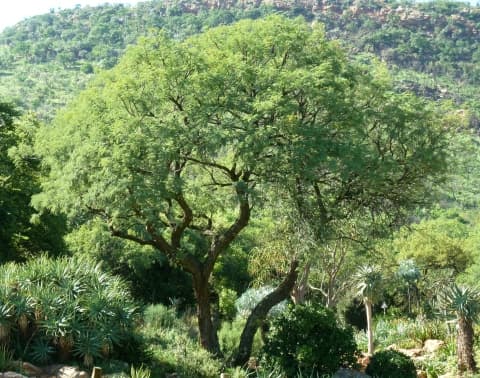
Senegalia caffra
Senegalia caffra
Safety & Hazards
The leaves and pods are eaten by livestock, but may cause poisoning[1]. Especially in times of drought, many Acacia species can concentrate high levels of the toxin Hydrogen cyanide in their foliage, making them dangerous for herbivores to eat.
Cultivation Details
A plant of drier regions in the tropics and subtropics, where it can be found at elevations up to 1,500 metres[1]. Mature plants can tolerate some frost[1]. Requires a sunny position[2]. Very tolerant of highly acid, sandy soils[2]. Established plants are drought tolerant[1]. A fast-growing species[1], with a growth rate of 70 - 90cm a year[2]. Avoid planting near paving or buildings as this species reportedly has an aggressive root system[2]. The tree responds well to coppicing[1]. The plant regenerates quickly after fire[2]. This species has a symbiotic relationship with certain soil bacteria, these bacteria form nodules on the roots and fix atmospheric nitrogen. Some of this nitrogen is utilized by the growing plant but some can also be used by other plants growing nearby.
Propagation
Seed - it has a hard seedcoat and may benefit from scarification before sowing to speed up germination. This can usually be done by pouring a small amount of nearly boiling water on the seeds (being careful not to cook them!) and then soaking them for 12 - 24 hours in warm water. By this time they should have imbibed moisture and swollen - if they have not, then carefully make a nick in the seedcoat (being careful not to damage the embryo) and soak for a further 12 hours before sowing. It is best to sow directly into deep pots as the young plant quickly forms a long taproot and is sensitive to transplanting[2]. Cite as: Tropical Plants Database, Ken Fern. tropical.theferns.info. 2026-02-20. <tropical.theferns.info/viewtropical.php?id=Senegalia+caffra>
Pollinators
Insects
References
- [1]Protabase - Plant Resources of Tropical Africa. — http://www.prota.org ↩︎An excellent on-line database with detailed information on over 3,200 species of useful plants of Africa.
- [2]PlantZAfrica.com — http://www.plantzafrica.com ↩︎An excellent site giving detailed descriptions and uses of many S. African plants.
- [3]African Flowering Plants Database — Conservatoire et Jardin Botaniques. · http://www.ville-ge.ch/musinfo/bd/cjb/africa/recherche.php ↩︎Contains information on over 150,000 plant names (including synonyms) giving a description and habitat, plus a distribution map.