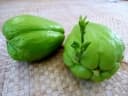
Sechium edule
Sechium edule
Safety & Hazards
None known
Cultivation Details
Chayote is a plant of the tropics and subtropics, it can also be grown as an annual crop in areas of the temperate zone that can offer a growing season of at least 6 months[1]. It can be grown at elevations up to 2,000 metres in the tropics, yielding better crops above 500 metres. It grows best in areas where annual daytime temperatures are within the range 19 - 30°c, but can tolerate 12 - 40°c[1]. Higher yields are achieved when there is a reasonable drop in temperatures over night[2]. Temperatures below 13°c cause damage to small unripe fruits, and the plant is killed by frosts[3]. It prefers a mean annual rainfall in the range 800 - 2,000mm, but tolerates 600 - 2,600mm[1]. The plant generally grows well in full sun, but some cultivars produce higher yields when grown in light shade[2]. It grows best in a sheltered position in a well-drained, fertile, humus-rich soil[3, 2, 1]. Prefers a pH in the range 5.5 - 7, tolerating 4.3 - 8[1]. Chayote is a long-lived perennial plant, but in cultivation it is recommended to renew it at least every 3 years because of disease problems[[3]. Plants can begin to produce a crop of immature fruits within 3 - 4 months from sowing the seed[4, 2] and then continue producing for a considerable time[2]. Individual plants grown on their own usually set a good crop of fruit[3]. Mature fruits can be produced 120 - 180 days after sowing the seed[1]. The tubers do not develop until the second year, and do not develop well in climates without a dry season. In regions with a season of arrested growth, they can reach 10 kilos in weight and resemble yam tubers[3]. Yields of up to 60 tonnes per hectare of mature fruits can been obtained[2]. A plant can produce 80 - 100 fruits a year plus 20 - 25 kilos of roots[5]. Plants are very susceptible to pests and diseases in wet climates[4]. The seed germinates in the ripe fruit whilst still on the mother plant. The stem of the seedling grows out from the fruit apex and curves upwards. It produces roots which abort if they do not make contact with soil[3]. The are many named varieties[2, 6].
Propagation
Seed - keep the seed inside the fruit when sowing[4]. A mature fruit, with the germinating seed inside, should be planted to two thirds of its length with its widest end down[2]. Stem cuttings 15 - 20cm long are sometimes used[2]. These should be planted in a shady position and kept moist until they have rooted[2]. Cite as: Tropical Plants Database, Ken Fern. tropical.theferns.info. 2026-02-20. <tropical.theferns.info/viewtropical.php?id=Sechium+edule>
Pollinators
Bees, Insects, Parthenocarpic
References
- [1]Ecocrop — http://ecocrop.fao.org/ecocrop/srv/en/home ↩︎Basic information on a wide range of useful plants, plus details of environmental needs where available.
- [2]Vegetables in the Tropics — Tindall. H. D. · MacMillan, Oxford. · 1983 · ISBN 0-333-24268-8 ↩︎An excellent, in-depth look at the main vegetable crops that can be grown in the Tropics, plus many less well-known plants.
- [3]Protabase - Plant Resources of Tropical Africa. — http://www.prota.org ↩︎An excellent on-line database with detailed information on over 3,200 species of useful plants of Africa.
- [4]Tropical Food Gardens — Norrington. L. · Bloomings Books (Melbourne) · 2001 · ISBN 1-876473-41-x ↩︎Excellent little book giving some basic information on a range of plants.
- [5]Flora of Guatemala — Standley P.C. & J. A. Steyermark · 1946 - 1976 · http://www.archive.org/ ↩︎A superb reference, though somewhat dated. Gives lots of plant uses as well as information on plant habit and habitat. The entire flora (13 volumes) can now be downloaded from http://www.archive.org/
- [6]Cornucopia II — Facciola. S. · Kampong Publications, California. · 1998 · ISBN 0-9628087-2-5 ↩︎The second edition of an excellent guide to the edible uses of plants, though it does not give any details of cultivation etc.
- [7]Edible Leaves of the Tropics — Martin. F. W.; Ruberte. R. M. & Meitzner. L. S. · Echo. USA. · 1998 · ISBN 0-9653360-1-8 ↩︎A terse guide, giving reasonable detail on the more common leaf crops and brief information on a wide range of lesser known plants.
- [8]The New RHS Dictionary of Gardening. 1992. — Huxley. A. · MacMillan Press · 1992 · ISBN 0-333-47494-5 ↩︎Excellent and very comprehensive, though it contains a number of silly mistakes. Readable yet also very detailed.
- [9]Medicinal Plants of the Guianas — DeFilipps, R. A.; Maina, S. L.; & Crepin, J. · Smithsonian Museum · http://botany.si.edu/bdg/medicinal/index.html ↩︎A down-loadable PDF document of a book in pre-publication awaiting illustration. An excellent, if rather terse, guide to the traditional medicinal uses of the plants of the region