Sclerocarya birrea
Sclerocarya birrea
Safety & Hazards
None known
Cultivation Details
A plant of low to medium elevations in hot, dry, tropical savannah and forest areas[1]. It grows in areas where the mean annual temperature is within the range 19 - 35°c; the mean annual rainfall is in the range 200 - 1,600mm; and there is a well-defined dry season[2, 3]. It prefers a warm, frost-free climate but is also found at high altitudes where temperatures may drop below freezing point for a very short period in winter[2]. Requires a sunny position[4]. An easily grown plant requiring very little attention once established, it succeeds in soils that are too poor to support other crops[5, 6]. It prefers well drained sandy soils and loams in the wild, though it is also often found growing on rocky hills[3]. The plant is very tolerant of saline soils[3]. Tolerates a pH in the range 4.5 - 6.5[6]. Young trees are susceptible to fire damage[7]. Marula is fast growing, reaching 3.5 metres in height within 8 years in areas with 600mm mean annual rainfall[8]. Mean heights of planted trees 4 - 5 years old in Israel were 4.1 - 6.2 metres, with boles 13 - 18 cm in diameter[8]. Wild trees in Mali, estimated 11 - 12 years and 32 years old, were 8.2 metres and 6.9 metres tall respectively, with boles 28cm and 45cm in diameter[8]. It is one of the fastest growing trees in South Africa, with a growth rate of up to 1.5 metres per year when young[2]. Trees have set fruit after just 3 years in a trial in Israel[9]. A single female tree can yield 2,100 - 9,100 fruits in a season, the fruits falling while still green and ripening on the ground[9]. A dioecious species, although occasional trees bear flowers of both sexes. Usually, both male and female forms need to be grown if fruit and seed are required.
Propagation
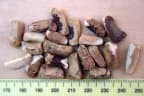
Seed - dried seed can retain its viability for several years[3]. The hard seed shell) forms a physical barrier to seed germination and removal of the opercula (lids) will significantly improve germination, with the seeds germinating faster and more uniformly. This must be done manually with a small chisel and is normally too time consuming to be feasible[3]. Germination has also been reported to be improved if the stones are cracked in a vice but this must be done carefully as the seeds are very fragile and easily damaged[3]. Furthermore, cracking may increase seed microflora. It is not recommended to extract the seeds. Treatment with acid has shown good results[3]. If the opercula have been removed, germination is fast and uniform, reaching 70% after one week and 85% after two weeks from sowing. Without treatment, germination may take as long as nine months[3]. It is easily propagated from cuttings[10]. Cite as: Tropical Plants Database, Ken Fern. tropical.theferns.info. 2026-02-20. <tropical.theferns.info/viewtropical.php?id=Sclerocarya+birrea>
Pollinators
Data unavailable
References
- [1]Perennial Edible Fruits of the Tropics : an Inventory — Martin, F. W.; Campbell, C. W.; Rubertbe, R. M. · U.S. Dept. of Agriculture, Agricultural Research Service · 1987 ↩︎A booklet giving terse details of almost 300 species of edible fruits, plus regional lists of Botanical and Common names for over 2,500 less well-known edible fruits of the tropics.
- [2]World Agroforesty Centre — http://www.worldagroforestry.org/ ↩︎An excellent online database of a huge range of trees giving very good information on each plant - its uses, ecology, identity, propagation, pests etc.
- [3]Seed Leaflets — Various · Forest & Landscape. Denmark · http://en.sl.life.ku.dk/Publikationer/Udgivelser/PopulaerPublikationer.aspx?katid={D28373CC-6EF3-4EF8-B097-6D83FABF209E}&serieid={9F1C3DB1-6E7B-4CF1-AF53-F480B0CB40EF}&sort=title ↩︎A series of leaflets, jointly produced by the University of Copenhagen and the Royal Botanic Gardens at Kew, focussing on seed information for a number species, but also giving a lot of other information about each plant.
- [4]Tropical and Subtropical Trees - A Worldwide Encyclopaedic Guide. — Barwick. M. · Thames & Hudson, London · 2004 · ISBN 0-500-51181-0 ↩︎A superb book, very concise and well written, giving a wealth of information on 400 or more species including descriptions, habitat, cultivation details and plant uses. A wealth of colour photographs bring each plant vividly to life.
- [5]Nuts. — Howes. F. N. · Faber · 1948 · ISBN - ↩︎Rather old but still a masterpiece. Has sections on tropical and temperate plants with edible nuts plus a section on nut plants in Britain. Very readable.
- [6]The New RHS Dictionary of Gardening. 1992. — Huxley. A. · MacMillan Press · 1992 · ISBN 0-333-47494-5 ↩︎Excellent and very comprehensive, though it contains a number of silly mistakes. Readable yet also very detailed.
- [7]Edible Wild Plants of Tanzania — Ruffo, C.K.: Birnie, A. & Tengnas, B. · Regional Land Management Unit; Nairobi. · 2002 · ISBN 9966-896-60-0 ↩︎A very well presented, simple guide to growing and utilizing wild food plants in Tanzania, with line drawings of each plant, a description, habitat and range, non-food as well as food uses, plus basic information on growing the plants.
- [8]Protabase - Plant Resources of Tropical Africa. — http://www.prota.org ↩︎An excellent on-line database with detailed information on over 3,200 species of useful plants of Africa.
- [9]Edible Nuts. — Wickens G.E. · FAO, Rome. · 1995 · http://www.fao.org/docrep/ · ISBN 92-5-103748-5 ↩︎Detailed information on 20 of the most valuable nut crops, plus more basic information on a wide range of other nut-producing plants. It can be downloaded from the Internet.
- [10]The Useful Plants of West Tropical Africa. — Burkil. H. M. · Royal Botanic Gardens; Kew. · 1985 - 2004 ↩︎Brief descriptions and details of the uses of over 4,000 plants. A superb, if terse, resource, it is also available electronically on the Web - see http://www.aluka.org/
- [11]Mansfeld's Database of Agricultural and Horticultural Plants — http://mansfeld.ipk-gatersleben.de/pls/htmldb_pgrc/f?p=185:3:4292127278597336 ↩︎Terse details of a huge range of useful plants.
- [12]Trees and Shrubs of the Sahel. Their Characteristics and Uses. — von Maydell H. · Deutsche Gesellschaft fur Technische Zusammenarbeit; Germany · 1990 · ISBN 3-8236-1198-4 ↩︎A well-researched book, usually with more than one photograph of each species and good information on the plant and its uses.
- [13]Cornucopia II — Facciola. S. · Kampong Publications, California. · 1998 · ISBN 0-9628087-2-5 ↩︎The second edition of an excellent guide to the edible uses of plants, though it does not give any details of cultivation etc.
- [14]Flora Zambesiaca — http://apps.kew.org/efloras/fz/intro.html ↩︎An excellent online flora of plants from the Zambezi River basin. It lists a number of the plant uses as well as the habitats and botanical descriptions of the plants.