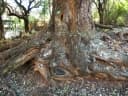
Schotia brachypetala
Schotia brachypetala
Safety & Hazards
It has been reported that wood dust may cause allergic reactions to the eyes[1].
Cultivation Details
A plant of drier areas in the tropics and subtropics. It is somewhat tolerant of frost, young plants require protection, but a well-established older tree in a protected spot, should be able to withstand a minimum of down to around -5°c[2, 1]. Prefers a position in full sun[3]. Young trees perform best when they have been planted in deep sandy soils with plenty of well-decomposed compost added[1]. Established trees are drought resistant[1]. The tree usually grows slowly, especially when on heavier soils, but when planted on deep sandy soils it may grow quite rapidly. A planted tree reached a height of 12 metres 17 years after being planted as a cutting[1]. Nectar is often so abundant that it drips from the flowers, which are visited by sunbirds, but also by insects such as bees, and by monkeys[2, 1]. Fruits ripen about 6 months after flowering. The seeds are probably mainly dispersed by birds attracted by the yellow arils[1]. Although many species within the family Fabaceae have a symbiotic relationship with soil bacteria, this species is said to be devoid of such a relationship and therefore does not fix atmospheric nitrogen[4].
Propagation
Seed - sow in a seedtray in a somewhat shaded position. Presoaking overnight in warm water is not essential, but may speed up the germination process. The seed usually germinates well[2]. Truncheon cuttings - take while the tree is not in active growth, and place in well-drained sandy soil in a cool shady spot and keep damp but not wet[2]. Cite as: Tropical Plants Database, Ken Fern. tropical.theferns.info. 2026-02-20. <tropical.theferns.info/viewtropical.php?id=Schotia+brachypetala>
Pollinators
Birds
References
- [1]Protabase - Plant Resources of Tropical Africa. — http://www.prota.org ↩︎An excellent on-line database with detailed information on over 3,200 species of useful plants of Africa.
- [2]PlantZAfrica.com — http://www.plantzafrica.com ↩︎An excellent site giving detailed descriptions and uses of many S. African plants.
- [3]Desert Tropicals — http://www.desert-tropicals.com/ ↩︎The main focus of the site is succulent plants, but it also contains information on a wide range of other species. Usually at least one good photograph, plus basic information about the plant and its cultivation.
- [4]Nodulation Plants in GRIN Taxonomy — United States Department of Agriculture · http://www.ars-grin.gov/~sbmljw/cgi-bin/taxnodul.pl?language=en ↩︎An online database listing plants that have either positive or negative reports on root and stem nodulation with nitrogen-fixing bacteria.
- [5]African Flowering Plants Database — Conservatoire et Jardin Botaniques. · http://www.ville-ge.ch/musinfo/bd/cjb/africa/recherche.php ↩︎Contains information on over 150,000 plant names (including synonyms) giving a description and habitat, plus a distribution map.