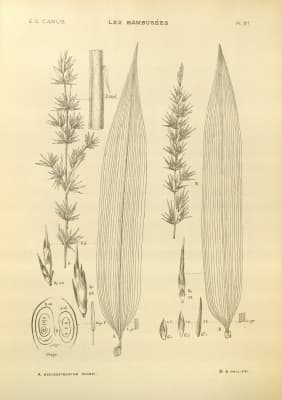
Schizostachyum lima
Schizostachyum lima
Safety & Hazards
None known
Cultivation Details
Requires relatively moist soil conditions[1]. Hardly any information is available on the growth and development of this plant. Three-year-old clumps contain on average 150 culms. Culms have their maximum diameter 2 metres above ground level[1]. Bamboos have an interesting method of growth. Each plant produces a number of new stems annually - these stems grow to their maximum height in their first year of growth, subsequent growth in the stem being limited to the production of new side branches and leaves. In the case of some mature tropical species the new stem could be as much as 30 metres tall, with daily increases in height of 30cm or more during their peak growth time. This makes them some of the fastest-growing species in the world[PFAF]. Bamboos in general are usually monocarpic, living for many years before flowering, then flowering and seeding profusely for a period of 1 - 3 years before usually dying. The sporadic flowering of this species occurs regularly, but gregarious flowering has never been reported[1].
Propagation
Seed - Cite as: Tropical Plants Database, Ken Fern. tropical.theferns.info. 2026-02-20. <tropical.theferns.info/viewtropical.php?id=Schizostachyum+lima>
Pollinators
Data unavailable
References
- [1]Plant Resources of Southeast Asia — http://proseanet.org/ ↩︎Lots of information on the uses of the plants of SE Asia.
- [2]Industrial Fiber Plants of the Philippines — Muller T. · Philippine Bureau of Education; Manila. · 1913 · http://www.biodiversitylibrary.org ↩︎An early guide to the fibre-producing plants of the Philippines.
- [3]Asean Tropical Plant Database — http://211.114.21.20/tropicalplant/index.jsp ↩︎Terse details, with photos, of many of the plants growing in the tropical forests of southeast Asia. Gives some details of plant uses along with a description of the plant and its range.
- [PFAF]Plants for a Future — pfaf.org ↩︎