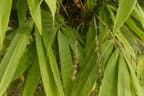
Schizostachyum brachycladum
Schizostachyum brachycladum
Safety & Hazards
None known
Cultivation Details
A plant of lowland tropical areas, where it is found at elevations below 600 metres[1]. Succeeds on any kind of soil but does best in a sandy loam[1]. Grows well in a well drained sandy clay or sandy loam soil[2]. Bamboos have an interesting method of growth. Each plant produces a number of new stems annually - these stems grow to their maximum height in their first year of growth, subsequent growth in the stem being limited to the production of new side branches and leaves. In the case of some mature tropical species the new stem could be as much as 30 metres tall, with daily increases in height of 30cm or more during their peak growth time. This makes them some of the fastest-growing species in the world[PFAF]. A mature clump contains about 30 - 50 culms[3]. Bamboos in general are usually monocarpic, living for many years before flowering, then flowering and seeding profusely for a period of 1 - 3 years before usually dying. The plant flowers continuously and each mature culm in an established clump bears inflorescences terminating leafy branches[1]. Mature fruits are rarely found[3]. This species normally retains its vegetative vigour undiminished after flowering[3].
Propagation
Seed - rarely formed[3]. Rhizome cuttings, consisting of a rhizome part, roots and a culm part, are the most common method of propagation[1]. Cuttings should be planted at the beginning of the rainy season, horizontally and with fresh buds side- ways, about 20 - 30 cm deep[1]. The soil should be finely crumbed[1]. Recommended spacing is 3 x 3 metres[1]. Culm cuttings[1]. Cite as: Tropical Plants Database, Ken Fern. tropical.theferns.info. 2026-02-20. <tropical.theferns.info/viewtropical.php?id=Schizostachyum+brachycladum>
Pollinators
Data unavailable
References
- [1]World Agroforesty Centre — http://www.worldagroforestry.org/ ↩︎An excellent online database of a huge range of trees giving very good information on each plant - its uses, ecology, identity, propagation, pests etc.
- [2]Bamboos of India: A Compendium — Seethalakshmi K.K., Muktesh Kumar M.S. · Brill. · 2002 · http://www.inbar.int/publication/txt/tr17/default.htm · ISBN 8186247254 ↩︎A very good book giving botanical descriptions of the plants with brief notes on subjects such as uses, habitat and range. It is also available to view on the Internet.
- [3]Plant Resources of Southeast Asia — http://proseanet.org/ ↩︎Lots of information on the uses of the plants of SE Asia.
- [PFAF]Plants for a Future — pfaf.org ↩︎